Belarus · Canada · Germany · Norway · Russian Federation · Ukraine · United States of America
File
Russia–Ukraine: origins, war since 2014 and timeline
This dossier traces the Russia–Ukraine war from the seizure of Crimea and the start of fighting in the Donbas in 2014, through the full-scale invasion of 24 February 2022 and its military, diplomatic, economic and humanitarian consequences. It distinguishes recognised sovereignty, claimed annexations and actual military control.
Earlier milestones explain relations between the two states since Ukrainian independence in 1991: the 1994 Budapest security assurances, the 1997 friendship treaty, the 2003 Tuzla crisis, gas disputes and the 2010 Kharkiv agreements. The suspension of preparations for the European Union agreement in November 2013 opens the Euromaidan crisis. These antecedents are distinguished from the war that began in 2014; each entry links to its sources.
The timeline follows Ilovaisk, Donetsk airport, Debaltseve, the Minsk agreements, disengagement attempts, fighting and the humanitarian crisis in Avdiivka in 2017, the trade blockade, detainee exchanges and the Kerch maritime crisis. It then documents the war’s expansion, Ukrainian territorial recaptures, Bakhmut, international justice, grain, energy, external assistance and negotiations. Retrospective investigations are identified and claims remain attributed.
This selection of turning points includes canonical occurrences from the archived energy dossier. It expands previously sparse years without providing an exhaustive daily record: local fighting, successive sanctions, all weapons deliveries and population displacement are not detailed. Cumulative military losses and complete territorial control remain coverage limitations.
Last updated : 80 key moments
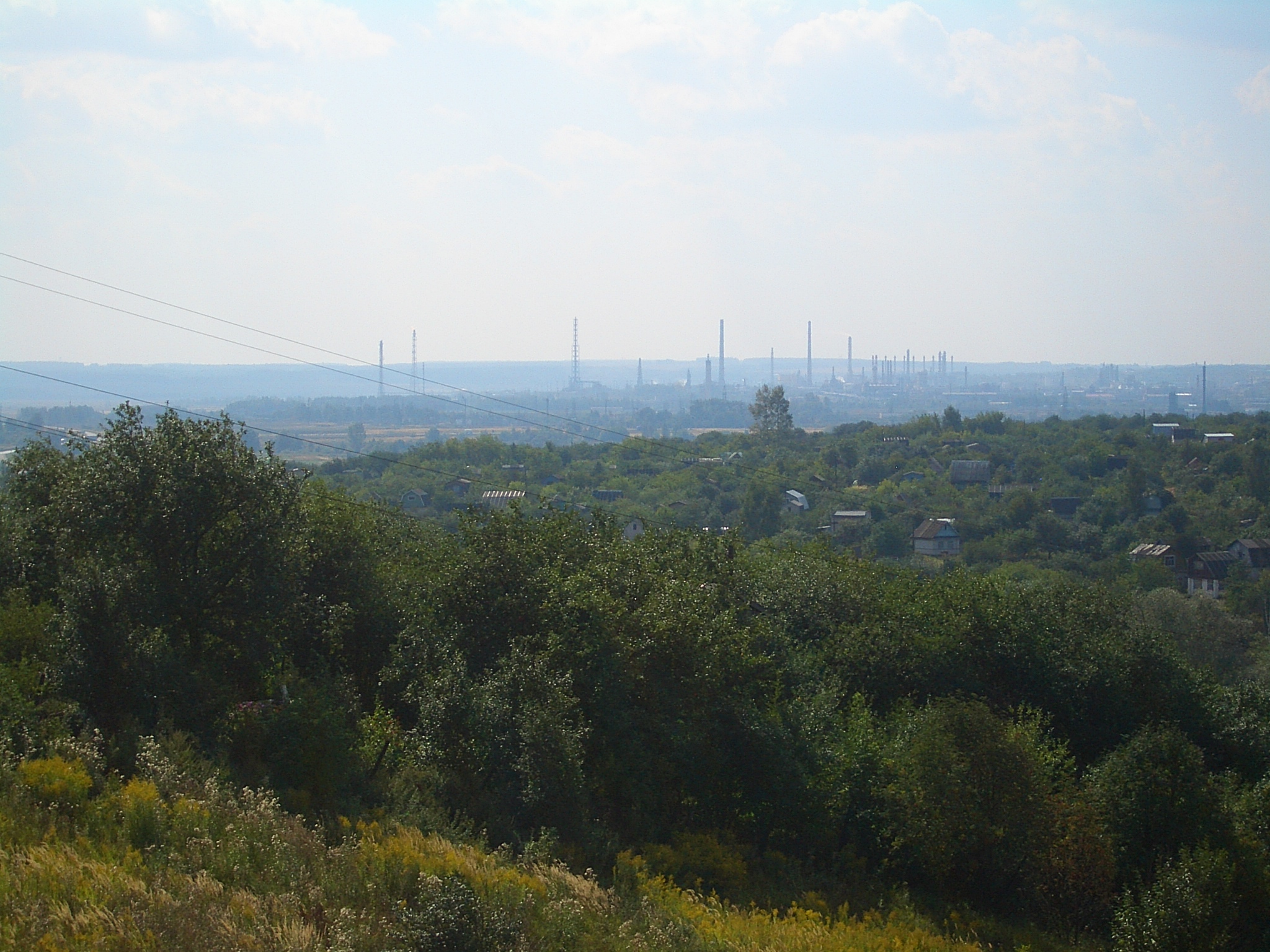
Kstovo industrial area, 29 August 2007. Archive image; it does not show the attack. Vmenkov, CC BY-SA 3.0 https://creativecommons.org/licenses/by-sa/3.0/, unchanged. — Vmenkov / Wikimedia Commons — CC BY-SA 3.0 https://creativecommons.org/licenses/by-sa/3.0/ — 29 août 2007, sans modification.
Where things stand
On 31 October 2026, residents evacuated from Russian-occupied Oleshky reached Kyiv-controlled territory after travelling through Russia and Belarus. The exact number arriving has not been published. The truce remains local. Washington has authorised a potential sale of 500 Patriot interceptors, with no evidence of delivery; the proposed €45 billion in EU loans for 2027 remains subject to adoption.
Reported information
Putin proclaims the annexation of four Ukrainian regions
On 30 September 2022, Vladimir Putin leads a Kremlin ceremony proclaiming the annexation of Donetsk, Luhansk, Kherson and Zaporizhzhia, Reuters reports.
Russian forces only partly occupy the regions claimed at the time. Russia’s sovereignty claim must be distinguished from actual territorial control.
The proclamation comes during the war after votes held under occupation. It does not turn the claimed administrative boundaries into a verified frontline or an internationally recognized border.
On 21 September 2022, Vladimir Putin announces a partial mobilisation to reinforce Russia’s campaign in Ukraine. Defence Minister Sergei Shoigu sets out a target of 300,000 reservists.
The decision follows Russian setbacks in the Kharkiv region. It expands recruitment beyond the forces already committed to the invasion.
The figure of 300,000 is the minister’s announced target, not a verified count of troops already trained and deployed to the front on the decree’s date.
Ukraine launches its Kharkiv-region counteroffensive
On 6 September 2022, Ukraine’s army launches a counteroffensive in Kharkiv region, according to France 24’s report published on 23 September.
The journalists interview soldiers and commanders who took part. Their reporting describes Russia’s withdrawal from strategic towns, including Izium, in the following days.
The date marks the offensive’s launch, not every territorial recapture. The sequence’s results are documented retrospectively without assigning one liberation date to all settlements.
On 22 July 2022 in Istanbul, Ukraine and Russia sign arrangements brokered by Türkiye and the UN to allow food exports from Ukrainian ports.
The Black Sea Grain Initiative provides a safe-transport and coordination mechanism. It covers the ports of Odesa, Chornomorsk and Pivdennyi, called Yuzhne in the UN statement.
The agreement concerns exports and is not a general ceasefire. Signing establishes a mechanism whose actual operation must be tracked separately.
On 23 June 2022, the European Council grants Ukraine candidate status for European Union membership, four months after Russia’s full-scale invasion began.
The decision recognises the country’s European perspective and places its application within the enlargement process. Progress depends on conditions and reforms specified by European institutions.
Candidate status is not membership and sets no accession date. It is nevertheless a major diplomatic step in the rapprochement begun before the war.
Moscow announces the surrender of Azovstal’s last defenders
On 20 May 2022, Russia’s Defence Ministry announces the surrender of the last Ukrainian troops inside Mariupol’s Azovstal steelworks, Reuters reports.
The announcement marks the reported end of the city’s last organized pocket of resistance after a devastating siege. The prisoners’ fate becomes an issue distinct from military control of Mariupol.
This entry preserves attribution of the Russian announcement. It does not adopt a comprehensive death toll for the siege, which the consulted evidence cannot verify.
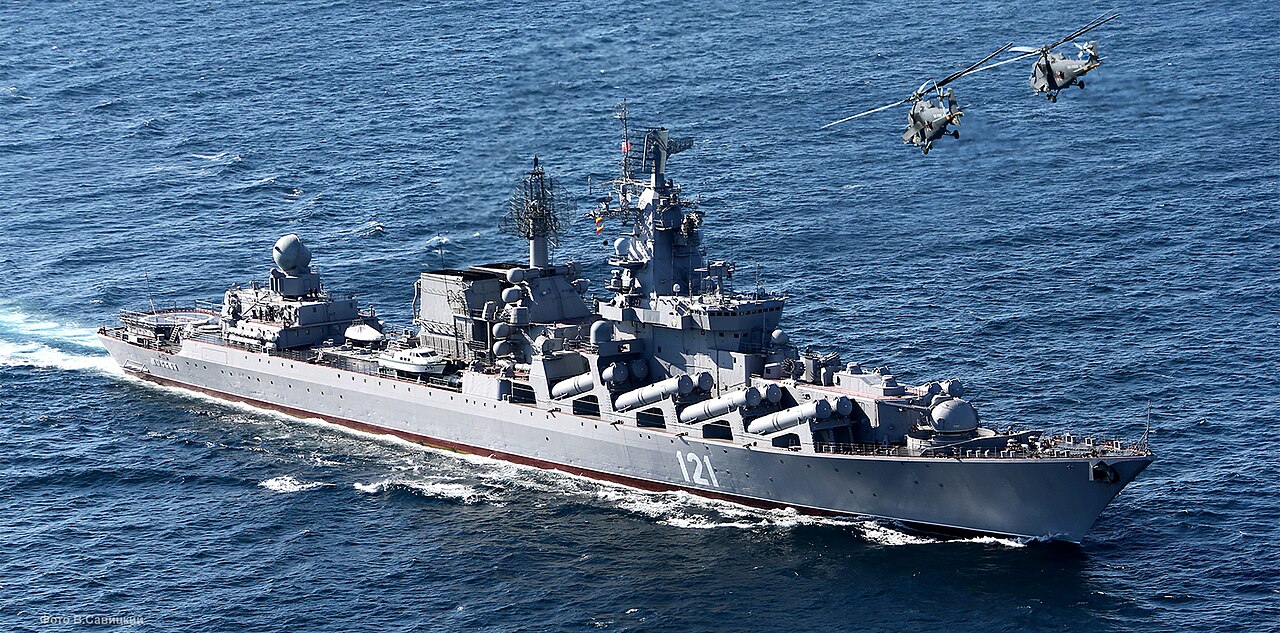
On 14 April 2022, Russia announces that the Moskva, flagship of its Black Sea Fleet, has sunk after an explosion and fire. Ukraine claims a missile strike.
Archive: the cruiser Moskva on 2 August 2012, almost ten years before it sank. Russian Defence Ministry photograph. — Vadim Savitsky / ministère russe de la Défense (Mil.ru) / Wikimedia Commons, CC BY 4.0 — https://creativecommons.org/licenses/by/4.0/. Archives du 2 août 2012, version réduite.
Moscow says the vessel sank while being towed in poor weather. Kyiv attributes the damage to Ukrainian missiles: initial sources do not make these accounts of the cause equivalent to an independent investigation.
The ship’s loss is a major naval setback. A complete casualty toll is not established by the contemporary evidence collected here.
Civilian bodies are found in Bucha after Russia’s withdrawal
On 2 April 2022, Ukrainian forces and journalists entering Bucha find numerous civilian bodies after Russian forces withdraw, according to OHCHR’s reconstruction.
The December 2022 report distinguishes the initial discoveries from later verification based on repeated visits. Human Rights Watch also conducts an on-site investigation in April.
These investigations document executions and other unlawful killings attributed to Russian troops. Their later findings are not presented as a comprehensive toll already available on the discovery date.
Ukraine: UN General Assembly demands Russian withdrawal on 2 March 2022
On 2 March 2022 in New York, the UN General Assembly adopted resolution ES-11/1, demanding the withdrawal of Russian forces from Ukraine. The vote was 141 in favour, 5 against and 35 abstentions, according to UN records and contemporary reporting.
In the text, the Assembly deplores Russian aggression and calls for an immediate end to the use of force. It demands a complete and unconditional withdrawal from Ukrainian territory within its internationally recognized borders.
Reuters reports that the vote concluded an emergency special session convened by the Security Council. This milestone records a diplomatic demand for withdrawal, rather than its implementation.
The official document was issued on 18 March 2022 but states that adoption took place on 2 March: the latter date places the decision in the timeline.
Russia launches its full-scale invasion of Ukraine
On 24 February 2022, Russia launches an invasion of Ukraine combining air strikes and ground forces, including an advance towards Kyiv.
Euronews and France 24 document the offensive announced by Vladimir Putin. The war thereby expands far beyond the earlier Donbas combat zones.
This turning point is distinct from the conflict’s beginning in 2014. The 2 March 2022 resolution demanding Russia’s withdrawal already appears as a separate event in this dossier’s timeline.
On 21 February 2022, Vladimir Putin announces Russia’s recognition of the separatist entities of Donetsk and Luhansk, Euronews reports.
The decision follows months of military and diplomatic tension. Kyiv and its partners reject this challenge to Ukrainian sovereignty.
It is a unilateral Russian recognition, distinct both from the full-scale invasion launched three days later and from international recognition of the territories.