Belarus · Canada · Germany · Norway · Russian Federation · Ukraine · United States of America
File
Russia–Ukraine: origins, war since 2014 and timeline
This dossier traces the Russia–Ukraine war from the seizure of Crimea and the start of fighting in the Donbas in 2014, through the full-scale invasion of 24 February 2022 and its military, diplomatic, economic and humanitarian consequences. It distinguishes recognised sovereignty, claimed annexations and actual military control.
Earlier milestones explain relations between the two states since Ukrainian independence in 1991: the 1994 Budapest security assurances, the 1997 friendship treaty, the 2003 Tuzla crisis, gas disputes and the 2010 Kharkiv agreements. The suspension of preparations for the European Union agreement in November 2013 opens the Euromaidan crisis. These antecedents are distinguished from the war that began in 2014; each entry links to its sources.
The timeline follows Ilovaisk, Donetsk airport, Debaltseve, the Minsk agreements, disengagement attempts, fighting and the humanitarian crisis in Avdiivka in 2017, the trade blockade, detainee exchanges and the Kerch maritime crisis. It then documents the war’s expansion, Ukrainian territorial recaptures, Bakhmut, international justice, grain, energy, external assistance and negotiations. Retrospective investigations are identified and claims remain attributed.
This selection of turning points includes canonical occurrences from the archived energy dossier. It expands previously sparse years without providing an exhaustive daily record: local fighting, successive sanctions, all weapons deliveries and population displacement are not detailed. Cumulative military losses and complete territorial control remain coverage limitations.
Last updated : 80 key moments
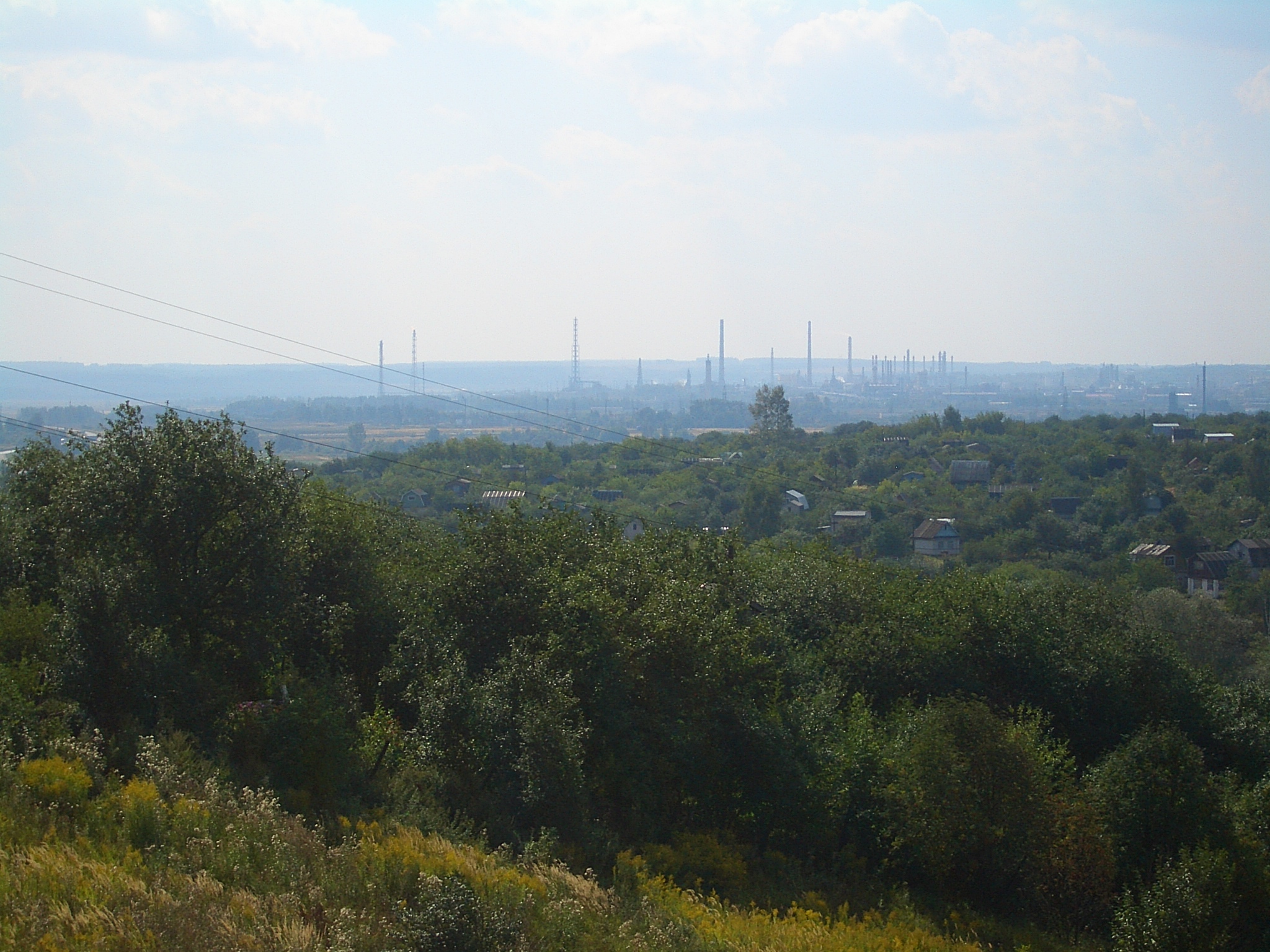
Kstovo industrial area, 29 August 2007. Archive image; it does not show the attack. Vmenkov, CC BY-SA 3.0 https://creativecommons.org/licenses/by-sa/3.0/, unchanged. — Vmenkov / Wikimedia Commons — CC BY-SA 3.0 https://creativecommons.org/licenses/by-sa/3.0/ — 29 août 2007, sans modification.
Where things stand
On 31 October 2026, residents evacuated from Russian-occupied Oleshky reached Kyiv-controlled territory after travelling through Russia and Belarus. The exact number arriving has not been published. The truce remains local. Washington has authorised a potential sale of 500 Patriot interceptors, with no evidence of delivery; the proposed €45 billion in EU loans for 2027 remains subject to adoption.
Confirmed
Nadiya Savchenko returns to Ukraine in an exchange with Russia
On 25 May 2016, Ukrainian soldier and lawmaker Nadiya Savchenko returns to Kyiv after a Russian pardon, while Alexander Alexandrov and Yevgeny Yerofeyev are sent back to Russia.
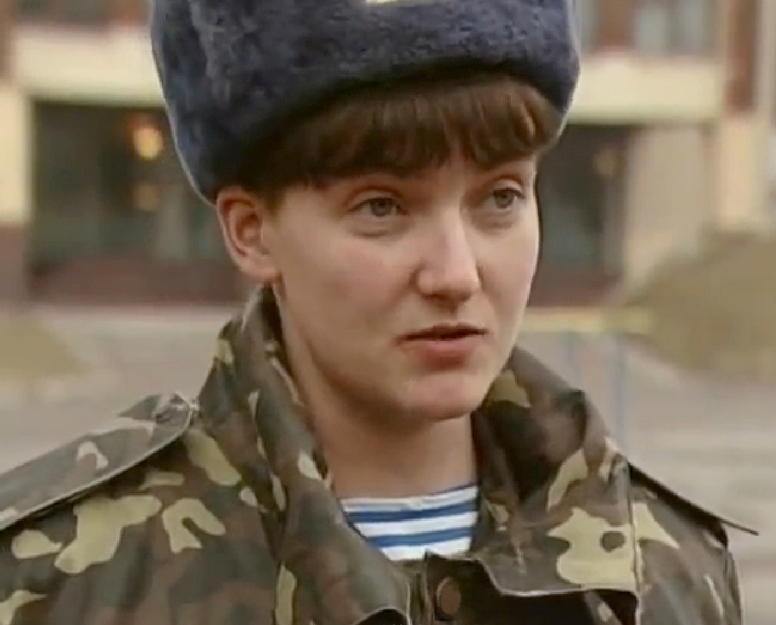
Archive portrait of Nadiya Savchenko from a January 2015 broadcast; this is not a photograph of her release. — Inter / Wikimedia Commons, CC BY 3.0 — https://creativecommons.org/licenses/by/3.0/. Capture d’archives de janvier 2015, recadrage préexistant ; aucune modification supplémentaire.
The two Russians had been convicted in Ukraine; Savchenko had been convicted in Russia in a case she contested. Pardons enable the reciprocal transfers.
The exchange resolves these individuals’ cases without ending the Donbas fighting or resolving the situation of other detainees.
Ukrainian forces withdraw from Debaltseve despite Minsk truce
On 18 February 2015, Ukrainian forces withdraw from Debaltseve, a strategic Donbas hub, after being encircled by separatist forces.
The departure comes six days after Minsk II was signed and after the ceasefire was scheduled to take effect. Fighting therefore continues in this sector despite the agreement.
Kyiv describes an organised withdrawal. Reporting describes losses with an uncertain toll: the troop movement is established, not a comprehensive casualty count.
On 12 February 2015, Minsk negotiations produce a new package of measures for the Donbas after talks involving Ukrainian, Russian, French and German leaders.
The framework combines a halt to fighting, withdrawal of heavy weapons and political provisions concerning separatist-held areas. The OSCE preserves the original text and Le Monde reports the talks’ outcome.
The agreement sets commitments for implementation. Its signature proves neither that fighting stopped nor that the envisaged reforms were carried out.
Ukrainian army abandons its main position at Donetsk airport
On 22 January 2015, Ukraine’s army acknowledges abandoning its main position at Donetsk airport after months of fighting against Russian-backed separatists.
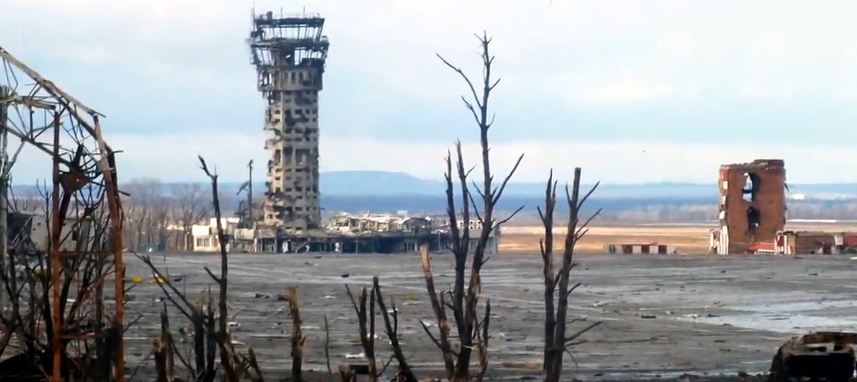
Archive: Donetsk airport ruins on 24 December 2014, before the January 2015 withdrawal. Still distributed by Pravda DPR. — Pravda DPR / Wikimedia Commons, CC BY 3.0 — https://creativecommons.org/licenses/by/3.0/. Capture vidéo du 24 décembre 2014, sans modification supplémentaire.
The terminal is devastated and the facility has lost its civilian function. January reporting describes both a military setback and a symbol of Ukrainian resistance.
Withdrawal from the main position does not mean all fighting around the site ends. This episode precedes the Minsk II negotiations in February.
On 5 September 2014, a protocol is signed in Minsk in an attempt to halt fighting in eastern Ukraine.
The OSCE publishes the document in its Russian original. It provides a framework for a ceasefire and negotiations.
Signing is a diplomatic act, separate from compliance on the ground. New talks in February 2015, reported by Le Monde, will show that this first framework did not deliver a lasting settlement.
Ukrainian withdrawal from Ilovaisk ends in disaster
On 29 August 2014, Ukrainian units try to break out of encirclement at Ilovaisk in the Donbas and suffer heavy losses during their withdrawal.
Accounts collected in early September describe an expected corridor and columns coming under fire. These contemporary testimonies alone do not establish the exact toll or the terms of the passage agreement.
An OHCHR investigation published in 2018 would document violations during the battle. Its later findings must be distinguished from information available on the day.
On 17 July 2014, Malaysia Airlines flight MH17 crashes near Hrabove in eastern Ukraine, killing all 298 people aboard.
The Dutch Safety Board’s technical report, published in October 2015, later establishes that a Buk missile warhead destroyed the aircraft. That finding came after the disaster and must not be presented as already established on 17 July.
The technical investigation explains the destruction mechanism; it is distinct from criminal proceedings concerning individual responsibility.
According to the OSCE’s retrospective report, Ukraine’s government launches a military operation on 13 April 2014 after armed groups seize public buildings in the east.
Parts of Donetsk and Luhansk regions fall outside Kyiv’s control. Separatist formations establish self-proclaimed authorities there.
The OSCE describes this sequence in its March 2015 humanitarian report. This entry dates the government’s military response; it does not assign a single starting day to all fighting in the Donbas.
Ukraine: UN General Assembly adopts resolution 68/262
On 27 March 2014 in New York, the UN General Assembly adopted resolution 68/262 on Ukraine’s territorial integrity. The vote was 100 in favour, 11 against and 58 abstentions, according to UN records and Reuters.
The text reaffirms Ukraine’s internationally recognized borders. It says the 16 March referendum in Crimea and Sevastopol cannot provide a basis for changing their status and calls for non-recognition of such a change.
Reuters notes that the resolution is non-binding. The vote therefore expresses a diplomatic position, without establishing a change in control on the ground. The document was issued on 1 April 2014, but explicitly records adoption on 27 March.
On 18 March 2014, Vladimir Putin signs a treaty in Moscow incorporating Crimea into Russia. Kyiv and Western countries reject the annexation.
The signature follows the 16 March referendum held after Russian forces seized strategic sites on the peninsula. It does not establish international recognition of a change of sovereignty.
This entry distinguishes Russia’s annexation act from the subsequent UN General Assembly decision, already documented in this dossier on 27 March.
Armed men seize Crimea’s parliament and government buildings
On 27 February 2014, armed men without insignia seize Crimea’s parliament and government headquarters in Simferopol, days after the change of power in Kyiv.
The buildings are occupied and the Russian flag is raised. Contemporary reporting describes forces whose identification remains uncertain at the time; that initial uncertainty must be distinguished from subsequent documentation of Russian intervention.
The seizure precedes the 16 March referendum and Moscow’s signing of the annexation on 18 March.