Belarus · Canada · Germany · Norway · Russian Federation · Ukraine · United States of America
File
Russia–Ukraine: origins, war since 2014 and timeline
This dossier traces the Russia–Ukraine war from the seizure of Crimea and the start of fighting in the Donbas in 2014, through the full-scale invasion of 24 February 2022 and its military, diplomatic, economic and humanitarian consequences. It distinguishes recognised sovereignty, claimed annexations and actual military control.
Earlier milestones explain relations between the two states since Ukrainian independence in 1991: the 1994 Budapest security assurances, the 1997 friendship treaty, the 2003 Tuzla crisis, gas disputes and the 2010 Kharkiv agreements. The suspension of preparations for the European Union agreement in November 2013 opens the Euromaidan crisis. These antecedents are distinguished from the war that began in 2014; each entry links to its sources.
The timeline follows Ilovaisk, Donetsk airport, Debaltseve, the Minsk agreements, disengagement attempts, fighting and the humanitarian crisis in Avdiivka in 2017, the trade blockade, detainee exchanges and the Kerch maritime crisis. It then documents the war’s expansion, Ukrainian territorial recaptures, Bakhmut, international justice, grain, energy, external assistance and negotiations. Retrospective investigations are identified and claims remain attributed.
This selection of turning points includes canonical occurrences from the archived energy dossier. It expands previously sparse years without providing an exhaustive daily record: local fighting, successive sanctions, all weapons deliveries and population displacement are not detailed. Cumulative military losses and complete territorial control remain coverage limitations.
Last updated : 80 key moments
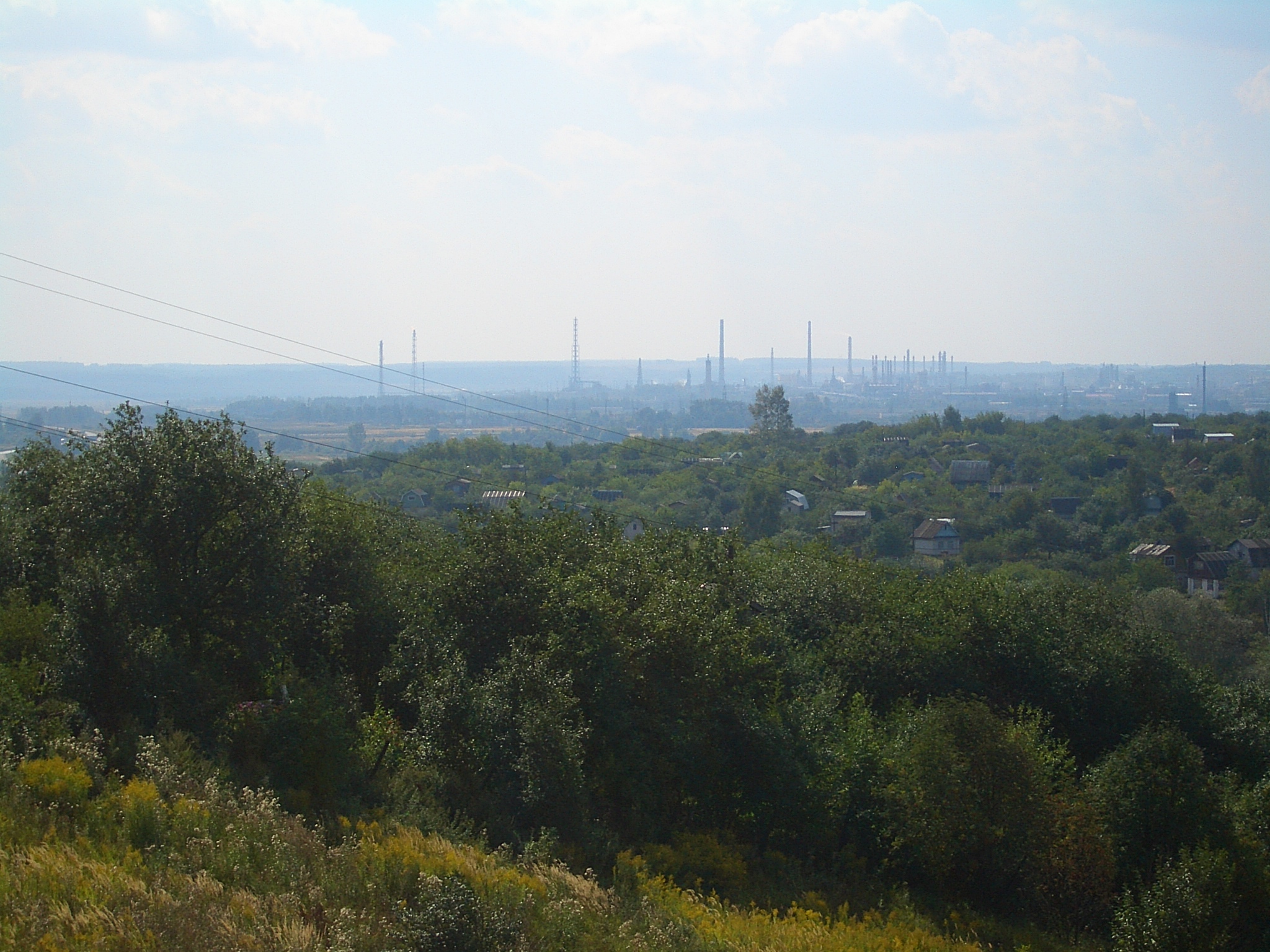
Kstovo industrial area, 29 August 2007. Archive image; it does not show the attack. Vmenkov, CC BY-SA 3.0 https://creativecommons.org/licenses/by-sa/3.0/, unchanged. — Vmenkov / Wikimedia Commons — CC BY-SA 3.0 https://creativecommons.org/licenses/by-sa/3.0/ — 29 août 2007, sans modification.
Where things stand
On 31 October 2026, residents evacuated from Russian-occupied Oleshky reached Kyiv-controlled territory after travelling through Russia and Belarus. The exact number arriving has not been published. The truce remains local. Washington has authorised a potential sale of 500 Patriot interceptors, with no evidence of delivery; the proposed €45 billion in EU loans for 2027 remains subject to adoption.
Confirmed
Civilian bodies are found in Bucha after Russia’s withdrawal
On 2 April 2022, Ukrainian forces and journalists entering Bucha find numerous civilian bodies after Russian forces withdraw, according to OHCHR’s reconstruction.
The December 2022 report distinguishes the initial discoveries from later verification based on repeated visits. Human Rights Watch also conducts an on-site investigation in April.
These investigations document executions and other unlawful killings attributed to Russian troops. Their later findings are not presented as a comprehensive toll already available on the discovery date.
Ukraine: UN General Assembly demands Russian withdrawal on 2 March 2022
On 2 March 2022 in New York, the UN General Assembly adopted resolution ES-11/1, demanding the withdrawal of Russian forces from Ukraine. The vote was 141 in favour, 5 against and 35 abstentions, according to UN records and contemporary reporting.
In the text, the Assembly deplores Russian aggression and calls for an immediate end to the use of force. It demands a complete and unconditional withdrawal from Ukrainian territory within its internationally recognized borders.
Reuters reports that the vote concluded an emergency special session convened by the Security Council. This milestone records a diplomatic demand for withdrawal, rather than its implementation.
The official document was issued on 18 March 2022 but states that adoption took place on 2 March: the latter date places the decision in the timeline.
Russia launches its full-scale invasion of Ukraine
On 24 February 2022, Russia launches an invasion of Ukraine combining air strikes and ground forces, including an advance towards Kyiv.
Euronews and France 24 document the offensive announced by Vladimir Putin. The war thereby expands far beyond the earlier Donbas combat zones.
This turning point is distinct from the conflict’s beginning in 2014. The 2 March 2022 resolution demanding Russia’s withdrawal already appears as a separate event in this dossier’s timeline.
On 21 February 2022, Vladimir Putin announces Russia’s recognition of the separatist entities of Donetsk and Luhansk, Euronews reports.
The decision follows months of military and diplomatic tension. Kyiv and its partners reject this challenge to Ukrainian sovereignty.
It is a unilateral Russian recognition, distinct both from the full-scale invasion launched three days later and from international recognition of the territories.
Russia publishes security demands to NATO and Washington
On 17 December 2021, Moscow publishes two draft agreements seeking, among other things, an end to NATO enlargement and restrictions on its military activities in Ukraine and eastern Europe.
The proposals come amid a renewed concentration of Russian forces around Ukraine. The United States and NATO reject a Russian veto over other states’ membership.
The documents are Russian negotiating demands. They are neither a concluded agreement nor commitments accepted by Ukraine or its partners.
On 22 April 2021, Moscow announces that troops will return to their bases after exercises and a major military buildup near Ukraine.
Reuters reports the following day Russia’s announcement that returns from annexed Crimea have begun. The buildup had caused concern in Kyiv and the West.
This entry documents the de-escalation announcement without certifying a full withdrawal of forces or equipment. It precedes the renewed crisis leading to the February 2022 invasion.
An agreement strengthens Donbas ceasefire measures
On 22 July 2020, the Trilateral Contact Group agrees additional ceasefire measures due to take effect on 27 July, the OSCE announces the next day.
The measures include bans on offensive operations and firing, alongside coordination and disciplinary mechanisms. They form part of efforts to implement Minsk.
This entry uses the agreement date. The statement alone cannot establish that weapons actually fell silent from 27 July.
Another detainee exchange takes place in eastern Ukraine
On 16 April 2020, Kyiv and separatist authorities in Donetsk and Luhansk conduct another exchange of conflict-related detainees, following the Paris discussions.
Ukraine’s presidency announces the return of twenty people. Reports from the day and OSCE mediation document the operation, organised while public health restrictions complicate contacts.
The number returning to Ukraine is attributed to the presidency. The exchange does not mean all commitments on detainee releases have been implemented.
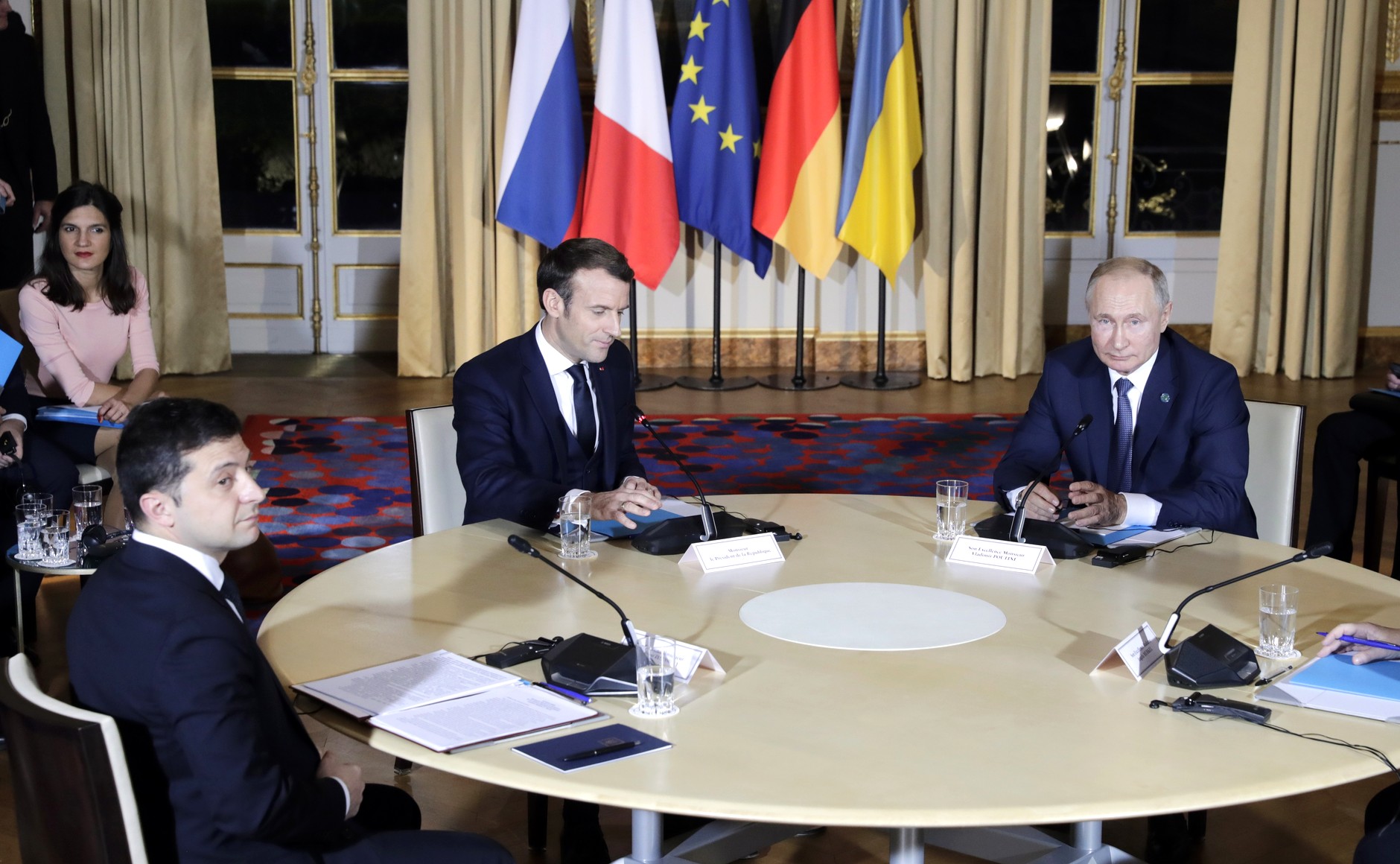
On 9 December 2019, Volodymyr Zelenskyy and Vladimir Putin attend a Paris summit with Emmanuel Macron and Angela Merkel.
Paris summit, 9 December 2019. Russian presidential photograph, kremlin.ru, CC BY 4.0. — Bureau de presse de la présidence russe / kremlin.ru / Wikimedia Commons, CC BY 4.0 — https://creativecommons.org/licenses/by/4.0/. Sommet du 9 décembre 2019 ; aucune modification.
The conclusions reaffirm Minsk as the negotiating framework and call for strengthening the ceasefire, facilitating prisoner exchanges and preparing further disengagement.
Reuters documents the Ukrainian and Russian presidents’ first meeting. The Paris commitments remain objectives: this entry does not assert their implementation or a settlement of the territories’ status.
Russia and Ukraine exchange thirty-five detainees each
On 7 September 2019, Russia and Ukraine exchange thirty-five detainees each. Oleg Sentsov and the twenty-four Ukrainian sailors captured in 2018 are among those returning to Ukraine.
Transfers take place by air between Moscow and Kyiv after negotiations. Those involved were held in different cases; the operation does not imply mutual recognition of all as prisoners of war.
The exchange opens a diplomatic sequence preceding December’s Paris summit without itself establishing a lasting peace.
Moscow eases naturalisation for residents of separatist-held areas
On 24 April 2019, Vladimir Putin signs a decree simplifying access to Russian citizenship for residents of areas of Donetsk and Luhansk outside Ukrainian government control.
The expedited procedure marks another step in administrative ties between Moscow and these territories. Kyiv and the European Union denounce an infringement of Ukrainian sovereignty.
The decree creates an opportunity for naturalisation; it does not establish that the entire population immediately receives Russian passports or change recognised borders.