Belarus · Canada · Germany · Norway · Russian Federation · Ukraine · United States of America
File
Russia–Ukraine: origins, war since 2014 and timeline
This dossier traces the Russia–Ukraine war from the seizure of Crimea and the start of fighting in the Donbas in 2014, through the full-scale invasion of 24 February 2022 and its military, diplomatic, economic and humanitarian consequences. It distinguishes recognised sovereignty, claimed annexations and actual military control.
Earlier milestones explain relations between the two states since Ukrainian independence in 1991: the 1994 Budapest security assurances, the 1997 friendship treaty, the 2003 Tuzla crisis, gas disputes and the 2010 Kharkiv agreements. The suspension of preparations for the European Union agreement in November 2013 opens the Euromaidan crisis. These antecedents are distinguished from the war that began in 2014; each entry links to its sources.
The timeline follows Ilovaisk, Donetsk airport, Debaltseve, the Minsk agreements, disengagement attempts, fighting and the humanitarian crisis in Avdiivka in 2017, the trade blockade, detainee exchanges and the Kerch maritime crisis. It then documents the war’s expansion, Ukrainian territorial recaptures, Bakhmut, international justice, grain, energy, external assistance and negotiations. Retrospective investigations are identified and claims remain attributed.
This selection of turning points includes canonical occurrences from the archived energy dossier. It expands previously sparse years without providing an exhaustive daily record: local fighting, successive sanctions, all weapons deliveries and population displacement are not detailed. Cumulative military losses and complete territorial control remain coverage limitations.
Last updated : 80 key moments
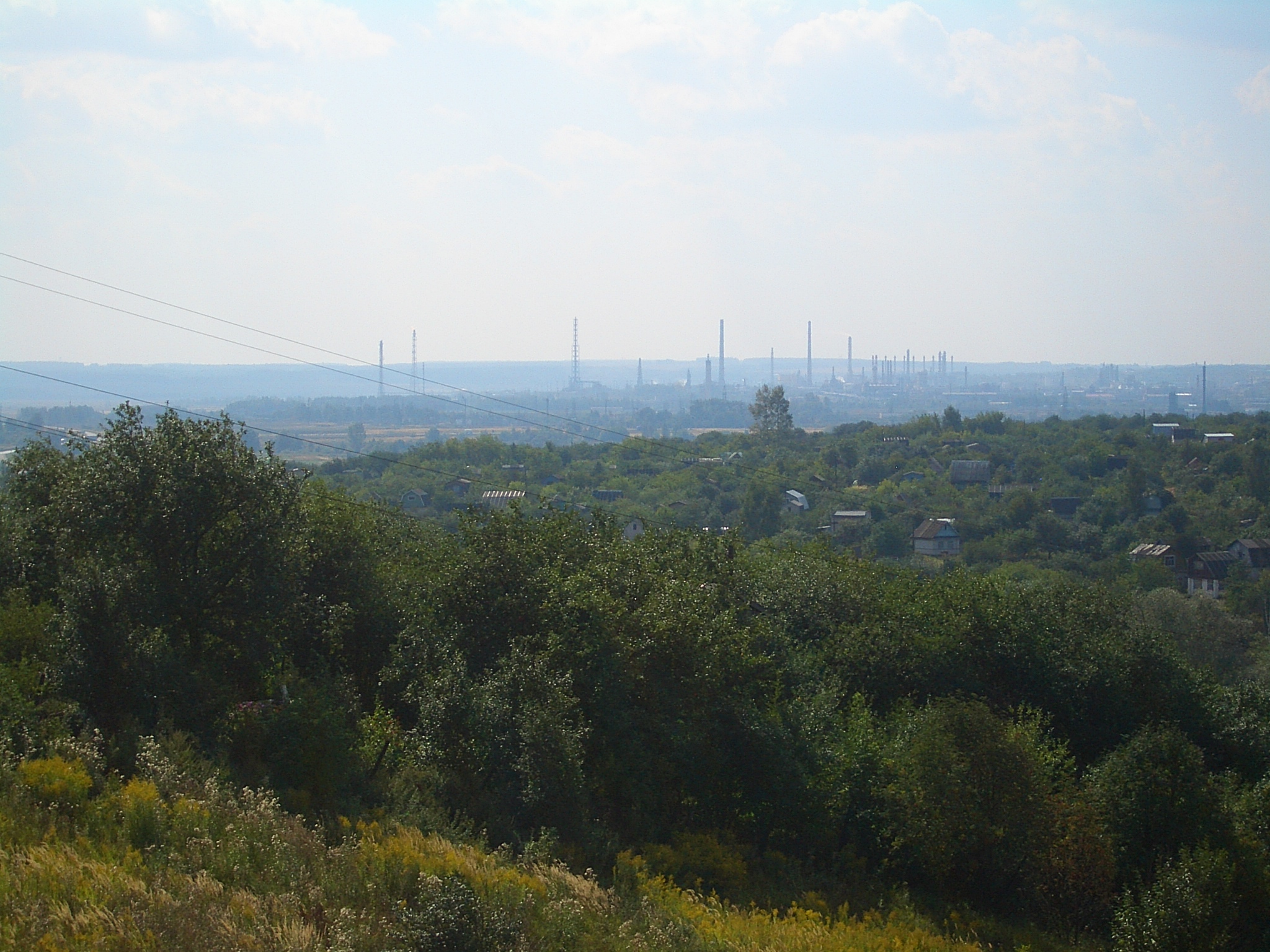
Kstovo industrial area, 29 August 2007. Archive image; it does not show the attack. Vmenkov, CC BY-SA 3.0 https://creativecommons.org/licenses/by-sa/3.0/, unchanged. — Vmenkov / Wikimedia Commons — CC BY-SA 3.0 https://creativecommons.org/licenses/by-sa/3.0/ — 29 août 2007, sans modification.
Where things stand
On 31 October 2026, residents evacuated from Russian-occupied Oleshky reached Kyiv-controlled territory after travelling through Russia and Belarus. The exact number arriving has not been published. The truce remains local. Washington has authorised a potential sale of 500 Patriot interceptors, with no evidence of delivery; the proposed €45 billion in EU loans for 2027 remains subject to adoption.
Reported information
Russia seizes three Ukrainian vessels near Kerch
On 25 November 2018, Russian forces open fire and seize three Ukrainian vessels near the Kerch Strait, Reuters reports.
The strait links the Black Sea to the Sea of Azov. Russia blocks passage at the time, while both governments accuse the other of provocation.
The naval confrontation adds a maritime dimension to the conflict already active in the Donbas. The report describes the seizure and the parties’ accounts without resolving every claim about navigation conditions.
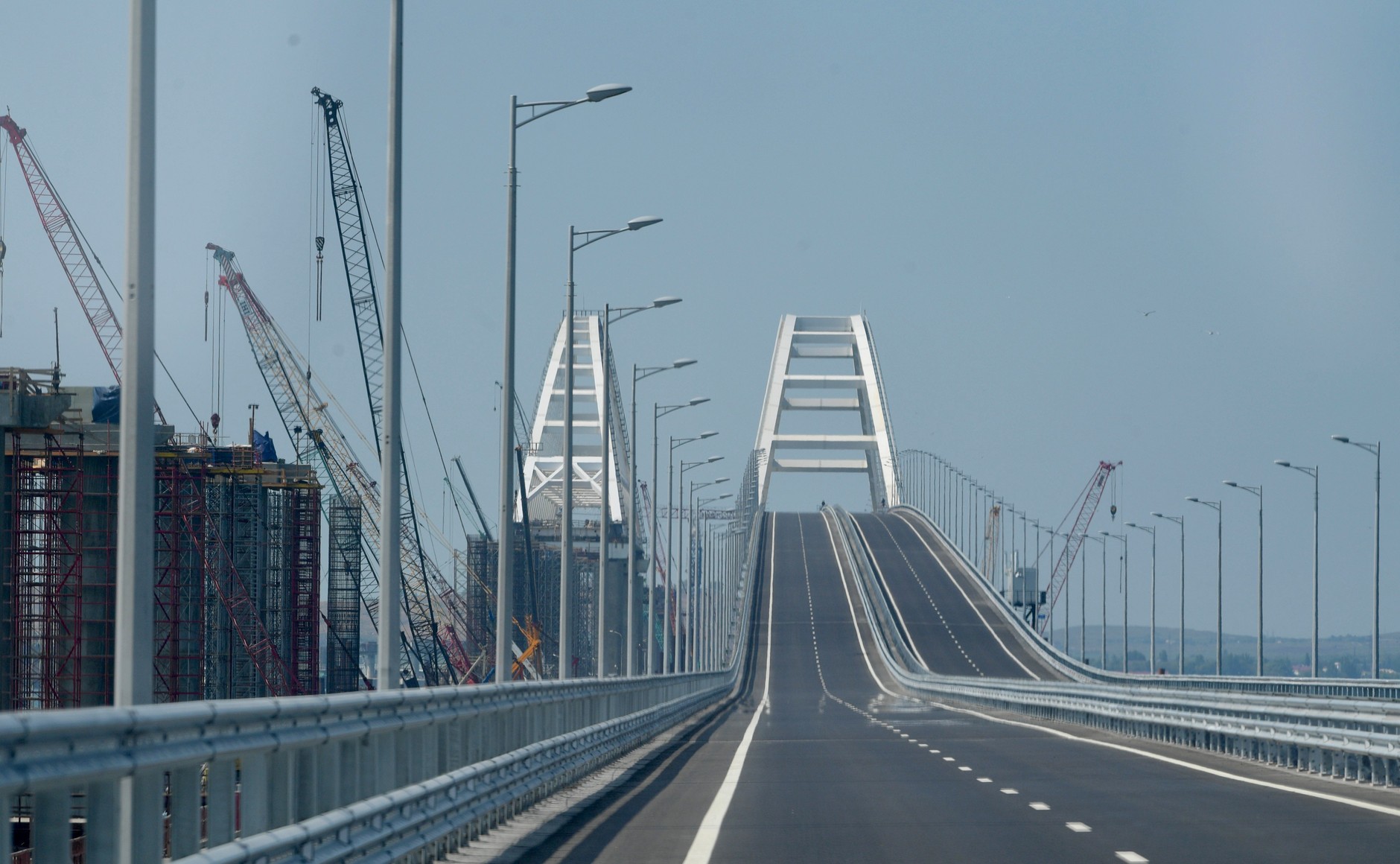
On 15 May 2018, Vladimir Putin inaugurates the road section of the bridge connecting Russia to Crimea across the Kerch Strait, four years after Moscow’s annexation of the peninsula.
The Kerch Bridge at its road inauguration on 15 May 2018. Official Russian photograph. — Kremlin.ru / Wikimedia Commons, CC BY 4.0 — https://creativecommons.org/licenses/by/4.0/. Photographie du 15 mai 2018, sans modification.
The structure creates a direct link to Russia’s road network. Ukraine and the European Union condemn construction undertaken without Kyiv’s agreement.
The road inauguration is distinct from railway service. Russian control and bridge construction do not change recognised Ukrainian sovereignty over Crimea.
Detainee exchange reunites families on both sides of the front
On 27 December 2017, Ukrainian authorities and separatists conduct a major detainee exchange near Maiorsk in the Donbas with ICRC participation.
The ICRC says it helped release and transfer more than 300 people held in connection with the conflict. Its delegates were able to speak privately with most of those concerned before their release.
The OSCE welcomes the humanitarian development while calling for respect for the ceasefire. The operation does not resolve every detainee’s situation.
Kyiv suspends freight traffic with separatist-held areas
On 15 March 2017, Ukrainian authorities decide to suspend freight traffic across the contact line with separatist-controlled areas of Donetsk and Luhansk.
The decision follows an activist-led railway blockade and separatist authorities’ seizure of businesses. Exceptions are provided for humanitarian deliveries.
The measure formalises an economic rupture between Kyiv-controlled territory and areas outside its control. It should not be confused with a blanket closure of all crossings for people.
Fighting leaves Avdiivka without power, water and heating
On 29 and 30 January 2017, fighting around Avdiivka damages water and electricity infrastructure, leaving residents without heating in midwinter.
UNICEF documents infrastructure damage and risks to children. On-site reporting describes residents seeking hot meals, blankets and assistance.
Power cuts prevent water pumping and affect heating. The humanitarian crisis is established; these observations do not identify which side fired every shell.
On 18 December 2016, heavy fighting resumes between Ukrainian forces and Russian-backed separatists near Svitlodarsk, north of Debaltseve.
OSCE observations and contemporary investigations describe intense artillery fire. Each side blames the other for starting the battle; their military casualty claims do not establish an independent comprehensive toll.
The escalation comes three months after the disengagement agreement and shows fighting continuing despite attempts to stabilise the contact line.
Agreement provides for disengagement in three Donbas areas
On 21 September 2016, the Trilateral Contact Group concludes a framework agreement in Minsk for disengagement of forces and equipment in eastern Ukraine.
The arrangement initially covers Stanytsia Luhanska, Zolote and Petrivske. The OSCE is to monitor withdrawals, subject to safe access to the areas concerned.
This is a commitment to implement, not proof of complete withdrawal on signing day. Access restrictions and continuing gunfire complicate verification.
Nadiya Savchenko returns to Ukraine in an exchange with Russia
On 25 May 2016, Ukrainian soldier and lawmaker Nadiya Savchenko returns to Kyiv after a Russian pardon, while Alexander Alexandrov and Yevgeny Yerofeyev are sent back to Russia.
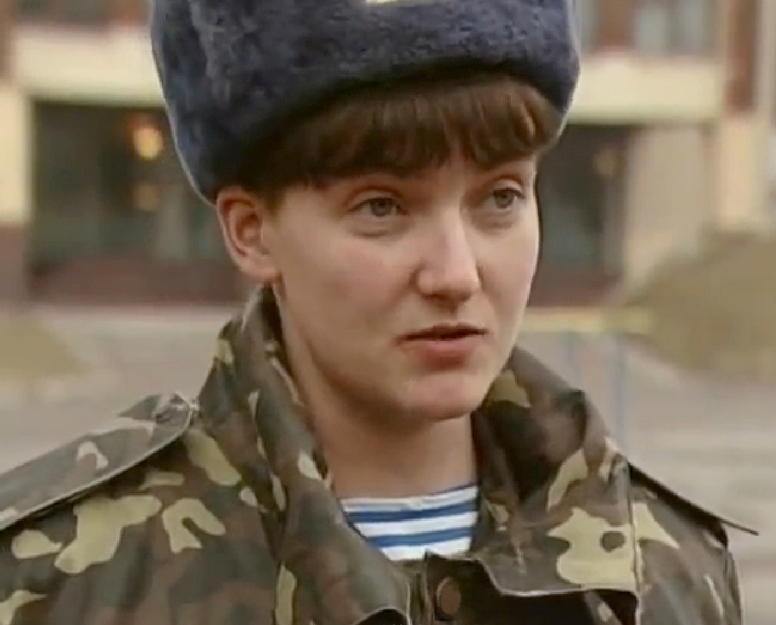
Archive portrait of Nadiya Savchenko from a January 2015 broadcast; this is not a photograph of her release. — Inter / Wikimedia Commons, CC BY 3.0 — https://creativecommons.org/licenses/by/3.0/. Capture d’archives de janvier 2015, recadrage préexistant ; aucune modification supplémentaire.
The two Russians had been convicted in Ukraine; Savchenko had been convicted in Russia in a case she contested. Pardons enable the reciprocal transfers.
The exchange resolves these individuals’ cases without ending the Donbas fighting or resolving the situation of other detainees.
Ukrainian forces withdraw from Debaltseve despite Minsk truce
On 18 February 2015, Ukrainian forces withdraw from Debaltseve, a strategic Donbas hub, after being encircled by separatist forces.
The departure comes six days after Minsk II was signed and after the ceasefire was scheduled to take effect. Fighting therefore continues in this sector despite the agreement.
Kyiv describes an organised withdrawal. Reporting describes losses with an uncertain toll: the troop movement is established, not a comprehensive casualty count.
On 12 February 2015, Minsk negotiations produce a new package of measures for the Donbas after talks involving Ukrainian, Russian, French and German leaders.
The framework combines a halt to fighting, withdrawal of heavy weapons and political provisions concerning separatist-held areas. The OSCE preserves the original text and Le Monde reports the talks’ outcome.
The agreement sets commitments for implementation. Its signature proves neither that fighting stopped nor that the envisaged reforms were carried out.
Ukrainian army abandons its main position at Donetsk airport
On 22 January 2015, Ukraine’s army acknowledges abandoning its main position at Donetsk airport after months of fighting against Russian-backed separatists.
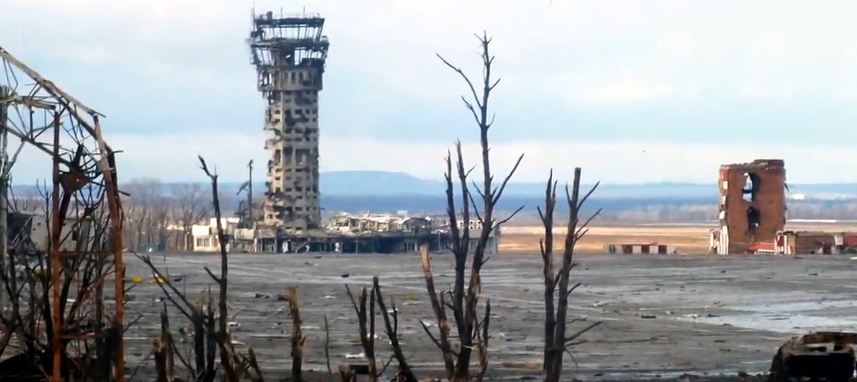
Archive: Donetsk airport ruins on 24 December 2014, before the January 2015 withdrawal. Still distributed by Pravda DPR. — Pravda DPR / Wikimedia Commons, CC BY 3.0 — https://creativecommons.org/licenses/by/3.0/. Capture vidéo du 24 décembre 2014, sans modification supplémentaire.
The terminal is devastated and the facility has lost its civilian function. January reporting describes both a military setback and a symbol of Ukrainian resistance.
Withdrawal from the main position does not mean all fighting around the site ends. This episode precedes the Minsk II negotiations in February.