Morocco · Algeria · Germany · Spain · France · United Kingdom · Mauritania · United States of America · Russian Federation
File
Moroccan Sahara: from the roots of the conflict to the 2026 negotiations
This dossier traces the origins and transformation of the Moroccan Sahara conflict: historical ties and allegiances, Spanish colonial rule from 1884, decolonisation, war, the referendum process, the autonomy proposal and diplomacy through 17 October 2026. It also covers populations, Hassani culture, Tindouf refugees, prisoners and missing persons, human rights, resources and trade agreements.
Morocco claims the territory on grounds of territorial integrity and historical ties; the Polisario Front seeks independence through self-determination, with Algerian support. Mauritania withdrew from the territorial conflict in 1979 but remains involved through neighbourhood interests and negotiations. Morocco administers the principal cities and Atlantic coast; the military berm is not an agreed international border. The dossier distinguishes effective control, sovereignty claims, bilateral recognition and status in international institutions.
In 1975, the ICJ recognised allegiance ties with certain tribes without finding territorial sovereignty that would exclude self-determination. The settlement plan accepted in 1988 and MINURSO established in 1991 did not deliver the planned referendum. The Baker initiatives and Morocco’s 2007 autonomy plan shifted negotiations towards institutions, safeguards and consent. US, Spanish, French and British positions use different wording and should not be counted as identical acts.
Sources accompany each milestone. “Moroccan Sahara” is the editorial designation; UN and court documents generally use “Western Sahara.” Their substantive qualifications are preserved. No map is used. Day-level dates do not imply a known time of day.
Last updated : 92 key moments
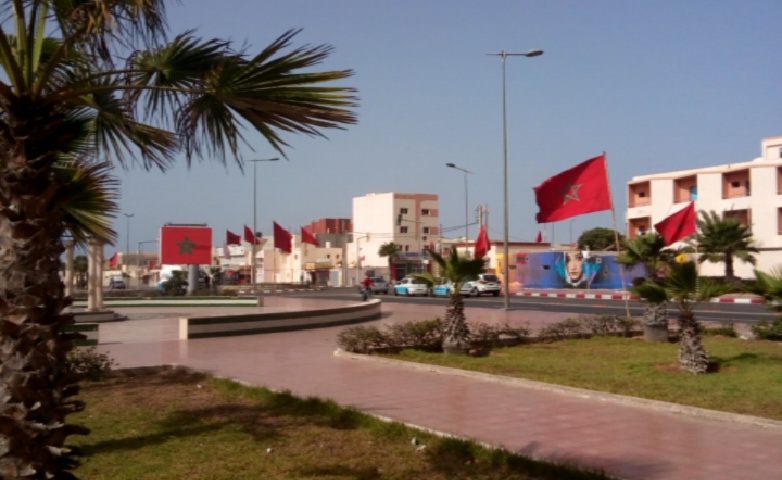
Dakhla, Moroccan Sahara, 5 September 2016. Illustrative view, no map. hamza / Hamiz11, CC BY-SA 4.0. — hamza / Hamiz11 — Wikimedia Commons — CC BY-SA 4.0, https://creativecommons.org/licenses/by-sa/4.0/ — photographie non modifiée
Where things stand
As of 1 November 2026, the UN announces MINURSO's liquidation while maintaining its political engagement. Médias24 observes reduced activity at headquarters in Laâyoune. An internal meeting is reported for 2 November, with no final departure timetable established. Parliament also plans a joint session on 2 November.
Viewpoints
Attributed and documented positions
Where do positions converge and diverge in seeking a settlement?
Common facts
UN texts seek a lasting, mutually acceptable political solution. Resolution 2797 gives Morocco’s autonomy proposal a central place. Sources establish no final agreement.
Main disagreement
Disagreement concerns sovereignty, the choices offered to the population and implementation guarantees. Algeria disputes being a party to the conflict; Morocco stresses its role. Protection of people remains a requirement distinct from status.
View detailed positionsHide detailed positions6
Kingdom of Morocco
summary
Morocco proposes negotiated autonomy under its sovereignty, with regional institutions and retention of sovereign state powers. The 2007 text provides consultation on the negotiated statute, not independence as an option. Rabat links this position to territorial integrity.
The Security Council supports negotiations based on Morocco’s autonomy proposal, without preconditions, towards a mutually acceptable solution providing for self-determination. It identifies genuine autonomy as a possible outcome and welcomes constructive suggestions. It does not find that a final agreement exists.
Mauritania describes its position in the UN report as positive neutrality and support for the political process. Its 1979 withdrawal distinguishes this from its former territorial claim. Border security and neighbourhood stability are direct interests.
HRW calls for safeguards for free and genuine choice, return and reparations. It says it takes no position on independence. Its criticism concerns rights and process safeguards; it is neither a court judgment nor the voice of every Sahrawi.
In positions recorded by the UN, Polisario demands that Sahrawis decide territorial status with independence among the options. It rejects fixing Moroccan sovereignty before that choice. Its willingness to talk does not establish acceptance of Rabat’s proposed outcome.
Algeria supports Polisario and self-determination while telling the UN envoy it does not consider itself a party to the conflict. It supports direct Morocco–Polisario talks with neighbouring states present. Participation does not resolve disagreement over its formal role.
Spanish withdrawal is followed by proclamation of the SADR
After Spain announces the end of its presence on 26 February 1976, Polisario proclaims the Sahrawi Arab Democratic Republic, or SADR, on 27 February.
War then pits Polisario against Morocco and Mauritania. People flee to Algeria’s Tindouf region; the camps become a lasting place of exile and the movement’s political centre. Proclamation does not mean universal recognition or UN membership. The SADR will nevertheless obtain bilateral recognitions and membership of the African organisation.
Morocco views its action as completing its territorial integrity; Polisario fights it in pursuit of independence. Algeria’s support strengthens the conflict’s regional dimension. No overall death toll for the war is asserted here because a broadly accepted independent series is unavailable.
Madrid agreement establishes a temporary tripartite administration
On 14 November 1975, Spain, Morocco and Mauritania sign a declaration in Madrid arranging a transfer of administrative responsibilities to a temporary tripartite administration.
The agreement opens Spain’s withdrawal and administration by Morocco and Mauritania in their respective areas. Polisario is not a signatory and rejects its consequences.
In his 2002 legal analysis, the UN Legal Counsel will explain that the text transferred neither sovereignty nor administering-Power status to the other signatories. It did not alter the territory’s UN classification. Signature, administrative and military consequences, and settlement of final status must therefore be distinguished: the latter does not follow simply from a transfer between three governments.
Green March accelerates the end of Spain’s presence
On 6 November 1975, Hassan II launches the Green March, a civilian mobilisation supporting Morocco’s territorial claim; the Security Council adopts resolution 380 the same day.
The event becomes a Moroccan symbol of territorial recovery and national unity. Its political importance must be distinguished from its international legal effect: resolution 380 deplores the march and calls for its participants to withdraw from the territory, while urging cooperation with the Secretary-General.
This occurs in the final weeks of Franco’s rule and amid negotiations over Spain’s withdrawal. It soon leads to the Madrid tripartite agreement. The dossier distinguishes Moroccan national memory, diplomacy that changes the balance of power and the exact content of UN texts.
ICJ recognises allegiance ties but finds no territorial-sovereignty ties
In its advisory opinion of 16 October 1975, the ICJ rejects the idea of an ownerless territory and recognises legal ties of allegiance between Morocco’s sultan and certain tribes.
The Court nevertheless finds no territorial-sovereignty ties with Morocco or the Mauritanian entity that could affect application of self-determination. It maintains the requirement for the free and genuine expression of the populations’ will.
Rabat stresses recognition of historical ties and bay‘a; independence advocates stress the conclusion on sovereignty and self-determination. Both elements belong to the same opinion. This is an advisory opinion: it assigns the territory neither to a Sahrawi republic that had not yet been proclaimed nor to Morocco. Reading it in full is essential to understanding the enduring legal disagreement.
On 13 December 1974, the General Assembly adopted resolution 3292 and requested an International Court of Justice advisory opinion on the Moroccan Sahara, then administered by Spain.
The questions concerned whether the territory belonged to no one at the time of Spanish colonisation and, if not, its legal ties with Morocco and the Mauritanian entity. The request placed these historical questions within the decolonisation process.
This was an advisory procedure, distinct from a judgment awarding sovereignty to a state. The 13 December decision opened the judicial sequence leading to the opinion of 16 October 1975, covered separately in this timeline.
The Popular Front for the Liberation of Saguia el-Hamra and Río de Oro, known as the Polisario Front, forms on 10 May 1973 and begins a struggle against Spanish rule.
The UN’s 1975 visiting-mission report describes a movement seeking independence and opposing the territorial claims of both Morocco and Mauritania. Polisario subsequently becomes Rabat’s main political and military opponent on this issue.
The movement, the diverse Sahrawi population and the republic it will proclaim in 1976 are distinct. Not all Sahrawis live in the Tindouf camps, and their political preferences cannot be inferred from identity alone. Algeria becomes Polisario’s main supporter; this regional support does not remove the need to examine the anti-colonial movement’s own history.
Zemla: Spanish repression marks Sahrawi mobilisation
On 17 June 1970, Spanish forces repress a Sahrawi demonstration in Zemla, Laayoune; leader Mohamed Bassiri is arrested and subsequently disappears, according to historical accounts cited by El País.
The protest challenges colonial administration and concerns the territory’s political future. It is an important precursor to the emergence of Polisario: Sahrawi mobilisation does not originate solely in the later confrontation with Morocco.
Accounts differ on the death toll and Bassiri’s precise fate. This dossier retains the reported repression and disappearance without treating casualty estimates or theories about his death as established facts. A full reconstruction would require cross-checking Spanish archives and witness testimony.
On 20 December 1966, General Assembly resolution 2229 called on Spain to establish arrangements for a UN-sponsored referendum for the indigenous population of the territory referred to here as the Moroccan Sahara.
The text sets out different approaches for Ifni, where negotiations with Morocco were requested, and the Sahara then administered by Spain. For the latter, it envisages consultations with the Moroccan and Mauritanian governments and other interested parties.
The resolution develops the call for decolonization made in 1965. It concerns a process to be organized; it does not establish that a vote took place or settle the territorial dispute. Its provisions are also documented in the CJEU Advocate General’s September 2016 opinion.
UN calls for the decolonisation of Ifni and Spanish Sahara
On 16 December 1965, the General Assembly adopts resolution 2072 (XX), calling on Spain to end colonial rule over Ifni and Spanish Sahara.
The roots precede armed conflict: tribal and nomadic societies, trans-Saharan trade, religious and political ties with Morocco’s sultans, then Spanish settlement from 1884. The allegiance ties invoked by Rabat will be examined by the ICJ in 1975. They do not automatically equate to the borders of a contemporary state.
Moroccan independence in 1956 opens a policy of recovering territories under European rule. Tarfaya is returned in 1958 and Ifni in 1969; their trajectories do not settle that of Spanish Sahara, listed by the UN as a Non-Self-Governing Territory in 1963. Resolution 2229 of 1966 calls for a UN-supervised referendum there. This establishes the intersection between Morocco’s territorial-integrity claim and the UN self-determination process.
At M’Hamid, Mohammed V asserts Morocco’s Sahara claim
In his 25 February 1958 speech at M’Hamid El Ghizlane, Mohammed V asserts Morocco’s determination to continue recovering its Sahara.
The speech links national unity, ties with Saharan populations and the tradition of royal visits. It is a primary source for Morocco’s position following independence in 1956.
This argument rests on historical continuity and bay‘a. The text establishes the position and its political significance; it should not be treated as an international ruling on territorial status. Predating Polisario’s creation, it helps explain Rabat’s presentation of the issue as completion of decolonisation and territorial integrity.