Morocco · Algeria · Germany · Spain · France · United Kingdom · Mauritania · United States of America · Russian Federation
File
Moroccan Sahara: from the roots of the conflict to the 2026 negotiations
This dossier traces the origins and transformation of the Moroccan Sahara conflict: historical ties and allegiances, Spanish colonial rule from 1884, decolonisation, war, the referendum process, the autonomy proposal and diplomacy through 17 October 2026. It also covers populations, Hassani culture, Tindouf refugees, prisoners and missing persons, human rights, resources and trade agreements.
Morocco claims the territory on grounds of territorial integrity and historical ties; the Polisario Front seeks independence through self-determination, with Algerian support. Mauritania withdrew from the territorial conflict in 1979 but remains involved through neighbourhood interests and negotiations. Morocco administers the principal cities and Atlantic coast; the military berm is not an agreed international border. The dossier distinguishes effective control, sovereignty claims, bilateral recognition and status in international institutions.
In 1975, the ICJ recognised allegiance ties with certain tribes without finding territorial sovereignty that would exclude self-determination. The settlement plan accepted in 1988 and MINURSO established in 1991 did not deliver the planned referendum. The Baker initiatives and Morocco’s 2007 autonomy plan shifted negotiations towards institutions, safeguards and consent. US, Spanish, French and British positions use different wording and should not be counted as identical acts.
Sources accompany each milestone. “Moroccan Sahara” is the editorial designation; UN and court documents generally use “Western Sahara.” Their substantive qualifications are preserved. No map is used. Day-level dates do not imply a known time of day.
Last updated : 92 key moments
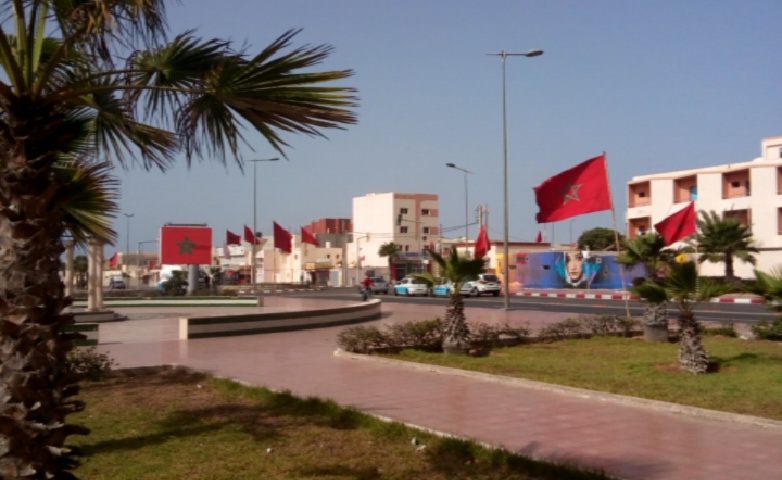
Dakhla, Moroccan Sahara, 5 September 2016. Illustrative view, no map. hamza / Hamiz11, CC BY-SA 4.0. — hamza / Hamiz11 — Wikimedia Commons — CC BY-SA 4.0, https://creativecommons.org/licenses/by-sa/4.0/ — photographie non modifiée
Where things stand
As of 1 November 2026, the UN announces MINURSO's liquidation while maintaining its political engagement. Médias24 observes reduced activity at headquarters in Laâyoune. An internal meeting is reported for 2 November, with no final departure timetable established. Parliament also plans a joint session on 2 November.
Viewpoints
Attributed and documented positions
Where do positions converge and diverge in seeking a settlement?
Common facts
UN texts seek a lasting, mutually acceptable political solution. Resolution 2797 gives Morocco’s autonomy proposal a central place. Sources establish no final agreement.
Main disagreement
Disagreement concerns sovereignty, the choices offered to the population and implementation guarantees. Algeria disputes being a party to the conflict; Morocco stresses its role. Protection of people remains a requirement distinct from status.
View detailed positionsHide detailed positions6
Kingdom of Morocco
summary
Morocco proposes negotiated autonomy under its sovereignty, with regional institutions and retention of sovereign state powers. The 2007 text provides consultation on the negotiated statute, not independence as an option. Rabat links this position to territorial integrity.
The Security Council supports negotiations based on Morocco’s autonomy proposal, without preconditions, towards a mutually acceptable solution providing for self-determination. It identifies genuine autonomy as a possible outcome and welcomes constructive suggestions. It does not find that a final agreement exists.
Mauritania describes its position in the UN report as positive neutrality and support for the political process. Its 1979 withdrawal distinguishes this from its former territorial claim. Border security and neighbourhood stability are direct interests.
HRW calls for safeguards for free and genuine choice, return and reparations. It says it takes no position on independence. Its criticism concerns rights and process safeguards; it is neither a court judgment nor the voice of every Sahrawi.
In positions recorded by the UN, Polisario demands that Sahrawis decide territorial status with independence among the options. It rejects fixing Moroccan sovereignty before that choice. Its willingness to talk does not establish acceptance of Rabat’s proposed outcome.
Algeria supports Polisario and self-determination while telling the UN envoy it does not consider itself a party to the conflict. It supports direct Morocco–Polisario talks with neighbouring states present. Participation does not resolve disagreement over its formal role.
MINURSO is renewed without a human rights monitoring mandate
On 25 April 2013, resolution 2099 extended MINURSO until 30 April 2014 without assigning it human rights monitoring in the Moroccan Sahara and the Tindouf camps.
The text stressed improving human rights and encouraged independent, credible measures. It welcomed the work of the National Human Rights Council’s commissions in Laâyoune and Dakhla and cooperation with UN mechanisms.
Those commitments were distinct from an operational MINURSO mandate. HRW had called for monitoring; its review of 2013 records that the function was not added. The Council also maintained support for Christopher Ross’s mediation.
On 17 May 2012, Morocco’s government announced that it was withdrawing confidence in Christopher Ross, the Secretary-General’s Personal Envoy for the Moroccan Sahara.
Rabat criticised what it regarded as biased and unbalanced mediation and stalled negotiations. Those assessments were the Moroccan authorities’ position, reported by Le Matin among others; they were not independent findings of bias.
A study by Thierry Desrues and Irene Fernández Molina in L’Année du Maghreb traces Ban Ki-moon’s continued support for Ross. Morocco’s decision opened a mediation crisis but did not amount to the envoy’s dismissal by the UN.
Morocco’s Constitution recognises the Saharan-Hassani component
The Constitution promulgated on 29 July 2011 recognises the Saharan-Hassani component of national identity and provides for preservation of Hassani in article 5.
This gives a legal framework to a central cultural dimension of the Moroccan Sahara. Language and cultural practices should not be reduced to diplomatic conflict or equated with a uniform political preference.
Cultural recognition alone does not establish the autonomy statute proposed in 2007. The national Constitution, administrative regionalisation and negotiated autonomy serve different functions. Linking them would require an explicit division of powers and institutional safeguards.
Dismantling of Gdeim Izik opens a lasting dispute over violence and trials
On 8 November 2010, Moroccan forces dismantle the Gdeim Izik protest camp near Laayoune; deadly clashes follow in the camp and the city.
Mobilisation includes social and economic grievances. Moroccan authorities report eleven security-force deaths during the sequence; HRW also reports civilian deaths and documents allegations of mistreatment after arrests. Findings must be attributed to their origin and date.
Proceedings in 2013 and 2017 fuel a lasting dispute over evidence, torture allegations and trial fairness. HRW continues to challenge their fairness in its report on 2025. Responsibility for violence and defendants’ safeguards are distinct questions: the dossier infers neither individual guilt nor innocence from political affiliation.
Aminatou Haidar returns to Laâyoune after hunger strike
On 18 December 2009, Sahrawi activist Aminatou Haidar returned to Laâyoune in the Moroccan Sahara after a 32-day hunger strike in Lanzarote.
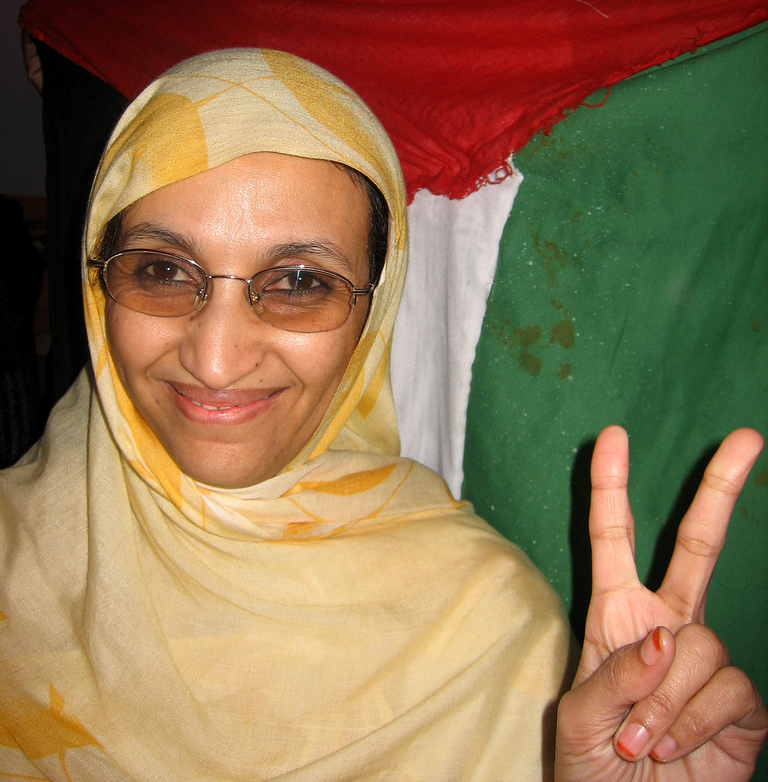
Aminatou Haidar on 18 January 2006. Archive portrait; it does not depict her December 2009 return. — Western Sahara (Saharauiak) / recadrage Tsui — Wikimedia Commons — CC BY-SA 2.0 https://creativecommons.org/licenses/by-sa/2.0/ — aucune modification supplémentaire.
Her removal to the Canary Islands in November and the confiscation of her passport had triggered a diplomatic crisis. Amnesty International welcomed her return and recalled calling for her access to her home and documents to be restored.
Spanish and Arabic-language coverage describes the diplomatic efforts surrounding the return. It resolved her immediate displacement without settling political disagreements. The event illustrates the individual consequences of movement restrictions and their international repercussions.
On 11 August 2009, Morocco and Polisario concluded informal talks in Dürnstein, Austria, led by Christopher Ross on the Moroccan Sahara.
Austria’s Foreign Ministry records the presence of Algerian and Mauritanian representatives. RTVE reports the delegations’ commitment to continuing the process after formal Manhasset meetings had stopped.
The format aimed to prepare further negotiations and restore exchanges. Closing announcements presented neither agreement on status nor a settlement of the conflict. Sources differ slightly on when the visit began; this milestone is therefore dated to the documented conclusion on 11 August.
Ban Ki-moon announces Christopher Ross as his choice of mediator
On 7 January 2009, Ban Ki-moon announced his intention to appoint Christopher Ross as Personal Envoy for the Moroccan Sahara, succeeding Peter van Walsum.
The American diplomat had served as ambassador to Algeria and Syria. The UN announcement tasked him with pursuing a just, lasting and mutually acceptable political solution providing for self-determination, based on Council resolutions.
Letter S/2009/20 of 8 January records the Security Council President’s response concerning the appointment. The change followed the four Manhasset rounds of 2007–2008. It renewed leadership of diplomatic contacts without itself constituting resumed negotiations or agreement on status.
Fourth Manhasset round explores family visits by land
The fourth Manhasset round ended on 18 March 2008 without narrowing differences on the Moroccan Sahara’s status, but with agreement to explore family visits by land.
Mediator Peter van Walsum’s communiqué records discussions on administration, justice and resources. Algeria and Mauritania attended the opening and closing sessions and were consulted separately.
Proposed land visits would supplement the existing air programme; exploring the option did not mean a road service had begun. The parties reaffirmed their commitment to continuing negotiations without setting a new date. Reuters reported the continuing political disagreement after the fourth session.
Manhasset opens a new round of direct negotiations
On 18–19 June 2007, Morocco and the Polisario Front met in Manhasset, near New York, for UN-sponsored negotiations on the Moroccan Sahara. Algeria and Mauritania were also represented.
The meeting followed Security Council resolution 1754, which called for negotiations in good faith and without preconditions. It came after Morocco submitted its autonomy proposal in April; opening talks was a separate step from submitting that initiative.
Delegations agreed to continue discussions in August. Resuming dialogue did not mean agreement on final status: Morocco advocated autonomy, while Polisario maintained its demand for self-determination including independence. The immediate outcome was a new negotiating cycle, without a settlement agreement.
Morocco submits its autonomy initiative to the Security Council
On 11 April 2007, Morocco submits to the UN an initiative to negotiate an autonomy statute for the Sahara region under Moroccan sovereignty.
The proposal envisages regional executive, legislative and judicial institutions, with powers over local affairs, development and financial resources. The state would retain defence, foreign affairs and attributes of sovereignty. The regional head of government would be elected by the regional parliament and invested by the King.
The negotiated statute would be submitted to a referendum and incorporated into the constitutional framework. This is different from a vote between independence and integration. Polisario advances an alternative based on self-determination including independence. Resolution 1754 opens negotiations without preconditions; Manhasset meetings in 2007–2008 produce no final agreement.
Mohammed VI reshapes CORCAS and seeks proposals on autonomy
On 25 March 2006 in Laâyoune, Mohammed VI appointed members of the reshaped Royal Advisory Council for Saharan Affairs and requested proposals on autonomy for the Moroccan Sahara.
The royal speech provided for tribal notables, elected representatives and civil society members, including women and young people. It assigned the council roles in proposing initiatives, mobilisation and development in the southern provinces.
The consultation concerned autonomy within Moroccan sovereignty. It prepared Morocco’s approach; it was neither a negotiated agreement with Polisario nor a status adopted by the UN. Al Jazeera reported the restructuring and Polisario’s rejection.