Morocco · Algeria · Germany · Spain · France · United Kingdom · Mauritania · United States of America · Russian Federation
File
Moroccan Sahara: from the roots of the conflict to the 2026 negotiations
This dossier traces the origins and transformation of the Moroccan Sahara conflict: historical ties and allegiances, Spanish colonial rule from 1884, decolonisation, war, the referendum process, the autonomy proposal and diplomacy through 17 October 2026. It also covers populations, Hassani culture, Tindouf refugees, prisoners and missing persons, human rights, resources and trade agreements.
Morocco claims the territory on grounds of territorial integrity and historical ties; the Polisario Front seeks independence through self-determination, with Algerian support. Mauritania withdrew from the territorial conflict in 1979 but remains involved through neighbourhood interests and negotiations. Morocco administers the principal cities and Atlantic coast; the military berm is not an agreed international border. The dossier distinguishes effective control, sovereignty claims, bilateral recognition and status in international institutions.
In 1975, the ICJ recognised allegiance ties with certain tribes without finding territorial sovereignty that would exclude self-determination. The settlement plan accepted in 1988 and MINURSO established in 1991 did not deliver the planned referendum. The Baker initiatives and Morocco’s 2007 autonomy plan shifted negotiations towards institutions, safeguards and consent. US, Spanish, French and British positions use different wording and should not be counted as identical acts.
Sources accompany each milestone. “Moroccan Sahara” is the editorial designation; UN and court documents generally use “Western Sahara.” Their substantive qualifications are preserved. No map is used. Day-level dates do not imply a known time of day.
Last updated : 92 key moments
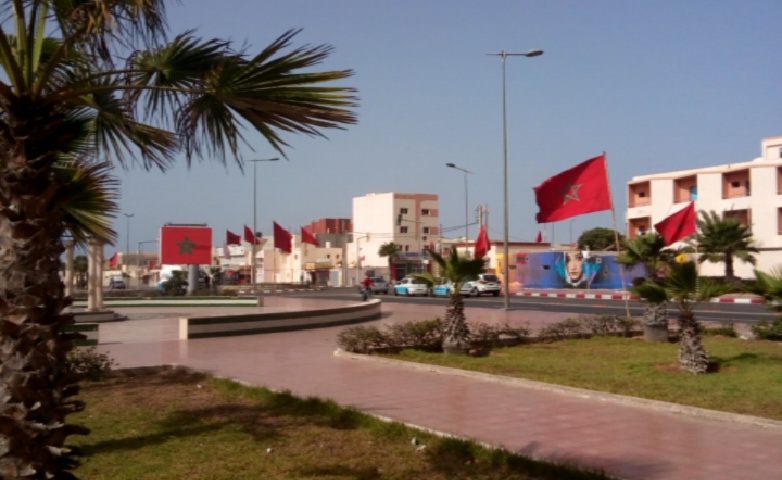
Dakhla, Moroccan Sahara, 5 September 2016. Illustrative view, no map. hamza / Hamiz11, CC BY-SA 4.0. — hamza / Hamiz11 — Wikimedia Commons — CC BY-SA 4.0, https://creativecommons.org/licenses/by-sa/4.0/ — photographie non modifiée
Where things stand
As of 1 November 2026, the UN announces MINURSO's liquidation while maintaining its political engagement. Médias24 observes reduced activity at headquarters in Laâyoune. An internal meeting is reported for 2 November, with no final departure timetable established. Parliament also plans a joint session on 2 November.
Viewpoints
Attributed and documented positions
Where do positions converge and diverge in seeking a settlement?
Common facts
UN texts seek a lasting, mutually acceptable political solution. Resolution 2797 gives Morocco’s autonomy proposal a central place. Sources establish no final agreement.
Main disagreement
Disagreement concerns sovereignty, the choices offered to the population and implementation guarantees. Algeria disputes being a party to the conflict; Morocco stresses its role. Protection of people remains a requirement distinct from status.
View detailed positionsHide detailed positions6
Kingdom of Morocco
summary
Morocco proposes negotiated autonomy under its sovereignty, with regional institutions and retention of sovereign state powers. The 2007 text provides consultation on the negotiated statute, not independence as an option. Rabat links this position to territorial integrity.
The Security Council supports negotiations based on Morocco’s autonomy proposal, without preconditions, towards a mutually acceptable solution providing for self-determination. It identifies genuine autonomy as a possible outcome and welcomes constructive suggestions. It does not find that a final agreement exists.
Mauritania describes its position in the UN report as positive neutrality and support for the political process. Its 1979 withdrawal distinguishes this from its former territorial claim. Border security and neighbourhood stability are direct interests.
HRW calls for safeguards for free and genuine choice, return and reparations. It says it takes no position on independence. Its criticism concerns rights and process safeguards; it is neither a court judgment nor the voice of every Sahrawi.
In positions recorded by the UN, Polisario demands that Sahrawis decide territorial status with independence among the options. It rejects fixing Moroccan sovereignty before that choice. Its willingness to talk does not establish acceptance of Rabat’s proposed outcome.
Algeria supports Polisario and self-determination while telling the UN envoy it does not consider itself a party to the conflict. It supports direct Morocco–Polisario talks with neighbouring states present. Participation does not resolve disagreement over its formal role.
CJEU upholds fisheries agreement while excluding waters adjacent to Sahara
On 27 February 2018, the CJEU held in case C-266/16 that the EU–Morocco fisheries agreement and its protocol did not apply to waters adjacent to the Moroccan Sahara, called “Western Sahara” in the proceedings.
Responding to a referral from a British court, the Court adopted an interpretation preserving the validity of the instruments examined while excluding those waters from their scope. Describing the judgment as a blanket annulment of all fisheries cooperation would therefore be inaccurate.
The decision extends the territorial-scope issue addressed in 2016 to a different instrument and access to marine resources. It requires a distinction between the agreement then in force, fishing authorizations and agreements negotiated later. It does not itself determine the political settlement of the dispute.
Polisario withdrawal from Guerguerat ends a phase of the standoff
On 28 April 2017, the UN announced the withdrawal of Polisario elements from Guerguerat in the southern Moroccan Sahara, following Morocco’s withdrawal announced on 26 February.
MINURSO observers confirmed the departure of Polisario elements on 27–28 April. The standoff had developed in 2016 around the road crossing the buffer strip towards Mauritania.
The same day, resolution 2351 extended the mission until 30 April 2018 and supported renewed negotiations. It noted that the crisis raised fundamental questions about the ceasefire and related agreements. Local de-escalation therefore settled neither the political dispute nor all questions about permitted activities in the area.
Morocco joins the African Union without a prior settlement
On 31 January 2017, Morocco joins the African Union after more than three decades outside the continental organisation.
The decision departs from the absence strategy adopted in 1984. Rabat can now defend its positions and develop African partnerships from within. The SADR remains an African Union member: Morocco’s return amounts neither to its expulsion nor to Moroccan recognition of its claims.
The African and UN frameworks continue to coexist. These institutional differences explain why an announcement by a state, consulate or organisation cannot be presented as a universal settlement. Countries’ positions need their precise wording and date.
CJEU excludes Sahara from the trade agreements under review
On 21 December 2016, the CJEU held that the EU–Morocco association and liberalization agreements examined in case C-104/16 P did not apply to the Moroccan Sahara, called “Western Sahara” in the judgment.
The Court also set aside the General Court’s judgment of 10 December 2015 and dismissed Polisario’s action as inadmissible. Both findings matter: the procedural outcome in the EU Council’s favour did not validate application of the agreements to the territory.
The reasoning rests on the territory’s separate and distinct status under international law and the relative effect of treaties. In a joint statement that day, the EU and Morocco acknowledged the judgment and reaffirmed their partnership. The ruling concerned those trade instruments; it was not a political agreement on final status.
Security Council seeks full MINURSO functionality after civilian staffing crisis
On 29 April 2016, the Security Council adopted resolution 2285, extended MINURSO until 30 April 2017 and stressed the urgent need to restore its full functionality in the Moroccan Sahara.
The decision followed the departure of international civilian personnel requested by Morocco in March amid its dispute with Ban Ki-moon. The Secretary-General’s report describes the operational consequences of reduced staffing; military observation and civilian functions must be distinguished.
The Council requested an assessment within 90 days of whether full functionality had been restored. That deadline concerned a review, not proof that restoration had already occurred. The resolution maintained the mission’s mandate without settling either the political dispute or the practical arrangements for restoring all its services.
EU General Court partly annuls decision approving trade agreement
On 10 December 2015, the EU General Court annulled the decision approving the EU–Morocco liberalisation agreement insofar as it approved application to the Moroccan Sahara.
In case T-512/12, the court accepted Polisario’s action. It faulted the Council for insufficient examination of the possible effects of resource exploitation on inhabitants and their fundamental rights.
The judgment concerned the act approving the agreement to that territorial extent; it did not cancel all EU–Morocco trade relations. Geneva’s Centre for European Legal Studies promptly analysed its scope. This first-instance judgment preceded the appeal ruling of 21 December 2016, already documented in the dossier.
Morocco launches a 77-billion-dirham development programme for its southern provinces
On 7 November 2015 in Laayoune, Morocco’s government presents a new development model for the southern provinces with an announced budget of 77 billion dirhams.
The programme combines infrastructure, economic transformation and social policies. It places phosphates, connectivity and employment within Morocco’s strategy for integrating the southern provinces and opening towards sub-Saharan Africa. Official documents announce expected production and employment effects; they do not independently measure achieved results.
Geographic scopes also differ: the “southern provinces” include administrative areas that do not exactly match former Spanish Sahara. Comparing budgets, populations or indicators therefore requires checking territorial coverage. Economic development, distribution of benefits and political settlement remain related but distinct questions.
Floods damage homes and food stocks in the Tindouf camps
By 23 October 2015, heavy rain had damaged homes and food stocks in the five Sahrawi refugee camps near Tindouf, Algeria.
UNHCR then announced assistance to approximately 25,000 people, or 5,000 families. This described assistance underway at that date, not a census of all refugees or a final count of people affected.
The International Federation of Red Cross and Red Crescent Societies’ later report documents damage and an assessment with the Algerian Red Crescent. It identifies needs for food, shelter and hygiene supplies. Camps named after cities in the Moroccan Sahara are located in Algeria and must not be confused with those cities.
On 18 October 2014, Human Rights Watch publishes an investigation of Polisario-administered camps near Tindouf, identifying infringements of some rights and Algeria’s protection responsibility.
The report criticises military trials of civilians and documents cases of mistreatment and residual slavery-like practices. It also says it found no evidence of widespread arbitrary restrictions preventing refugees from leaving the camps.
These findings must be read together within their 2014 scope: they justify neither denying documented abuses nor claiming all residents are held against their will. An older investigation is not verification of every individual situation in 2026.
MINURSO is renewed without a human rights monitoring mandate
On 25 April 2013, resolution 2099 extended MINURSO until 30 April 2014 without assigning it human rights monitoring in the Moroccan Sahara and the Tindouf camps.
The text stressed improving human rights and encouraged independent, credible measures. It welcomed the work of the National Human Rights Council’s commissions in Laâyoune and Dakhla and cooperation with UN mechanisms.
Those commitments were distinct from an operational MINURSO mandate. HRW had called for monitoring; its review of 2013 records that the function was not added. The Council also maintained support for Christopher Ross’s mediation.
On 17 May 2012, Morocco’s government announced that it was withdrawing confidence in Christopher Ross, the Secretary-General’s Personal Envoy for the Moroccan Sahara.
Rabat criticised what it regarded as biased and unbalanced mediation and stalled negotiations. Those assessments were the Moroccan authorities’ position, reported by Le Matin among others; they were not independent findings of bias.
A study by Thierry Desrues and Irene Fernández Molina in L’Année du Maghreb traces Ban Ki-moon’s continued support for Ross. Morocco’s decision opened a mediation crisis but did not amount to the envoy’s dismissal by the UN.