Egypt · France · United Kingdom · Israel · Jordan · Lebanon · State of Palestine · Qatar · Saudi Arabia · Syrian Arab Republic · United States of America
File
Israeli–Palestinian conflict: from its origins to today
This dossier traces the modern origins and major stages of the Israeli–Palestinian conflict from the late nineteenth century to today: national movements, the British Mandate, Israel’s creation and the Nakba, wars, occupation and settlements, Palestinian mobilization, peace efforts, political divisions, humanitarian crises and international proceedings. Each published occurrence includes its sources and distinguishes established facts, attributed statements and judicial findings. The timeline needs further detail on local settlement developments, some regional episodes and negotiations; it does not claim to catalogue every incident.
Last updated : 109 key moments
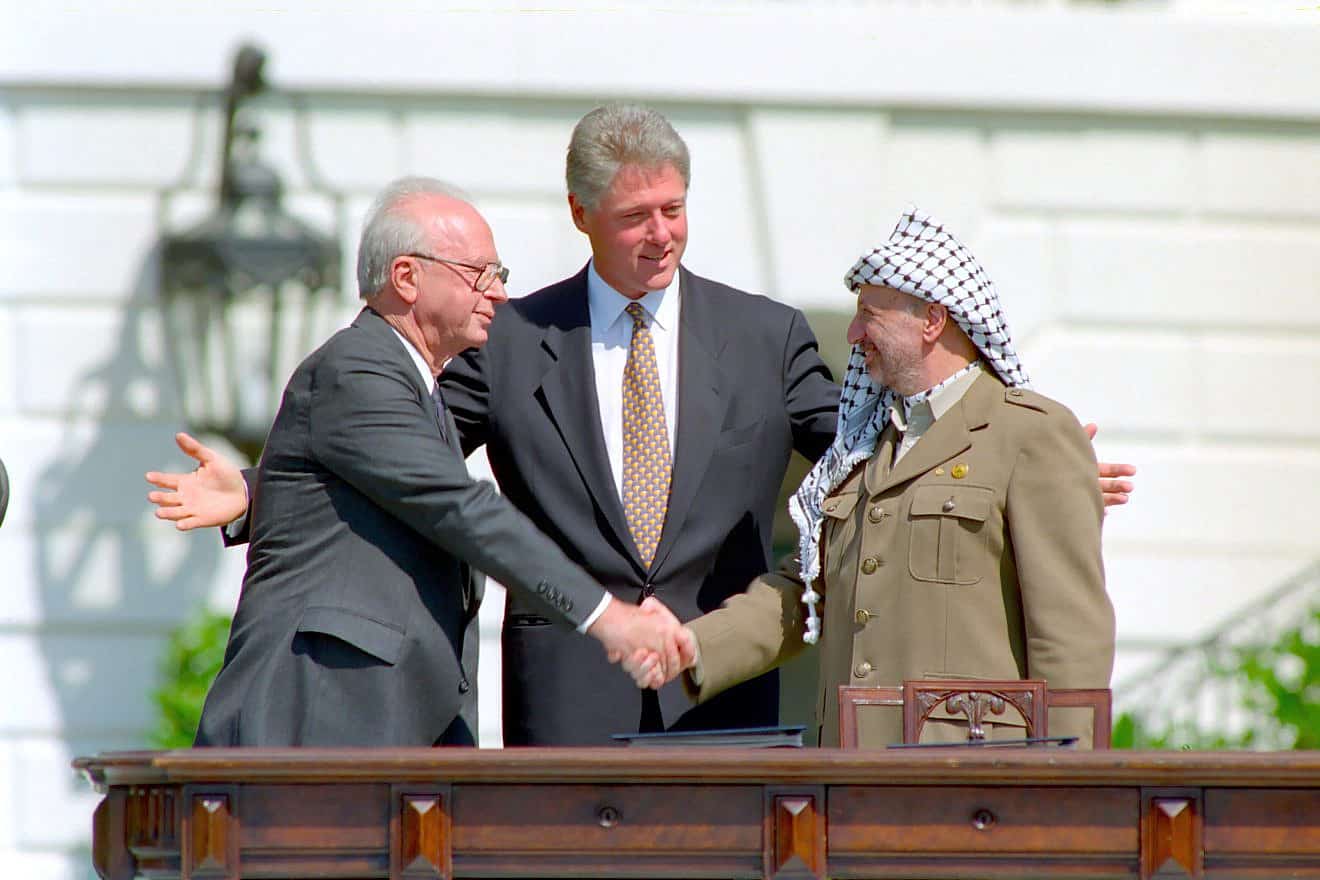
Signing of the Oslo accords in Washington, 13 September 1993. Vince Musi / White House, public domain. Archival photograph. — Vince Musi / The White House / Wikimedia Commons — domaine public, 13 septembre 1993.
Where things stand
As of 4 November 2026, the dossier contains 109 dated occurrences beginning in 1882. Following the ceasefire that took effect on 10 October 2025 and the release of the last twenty living Israeli hostages on 13 October, entries for October and November 2026 document continuing strikes and severe humanitarian difficulties in Gaza. Recent UN reports address displacement, access to health care and waste collection. Casualty figures remain attributed to their sources, with verification limits stated. The West Bank situation and regional developments require more detailed coverage.
Confirmed
ICJ finds wall built in occupied territory unlawful
On 9 July 2004, the International Court of Justice delivers its advisory opinion on the wall Israel is building in occupied Palestinian territory.
The Court finds its construction and associated regime there contrary to international law. The opinion concerns the route in occupied territory, including around East Jerusalem. It is an advisory opinion, distinct from a criminal judgment against individuals.
On 30 April 2003, the Quartet presents Israel and the Palestinian Authority with a roadmap towards a two-state solution.
The plan combines political, security, humanitarian and institutional steps and initially targets a settlement in 2005. Its deadlines are announced goals, not achieved outcomes. It sets reciprocal obligations, including on violence and settlement activity.
Israel launches Operation Defensive Shield in the West Bank
On 29 March 2002, the Israeli army launches Operation Defensive Shield, a major offensive in West Bank cities following a series of attacks including Netanya.
Israel describes the operation as targeting networks responsible for attacks. Fighting reaches Jenin and Nablus. Human Rights Watch documents serious civilian abuses and obstruction of relief in Jenin; these findings are distinct from initial unsubstantiated allegations of a large-scale massacre.
On 28 March 2002, the Arab League summit in Beirut adopts an initiative proposed by Saudi Crown Prince Abdullah.
It offers normal relations with Israel within a comprehensive peace in exchange for withdrawal from territories occupied since 1967, a Palestinian state with East Jerusalem as capital and an agreed refugee solution. It is a diplomatic offer, not a treaty signed with Israel.
On 27 January 2001, Israeli and Palestinian negotiators end the Taba talks without agreement while saying they have narrowed their differences.
Discussions concern borders, Jerusalem, refugees and security. They take place during the second Intifada and before Israel’s election. Progress claimed by the delegations should not be confused with a concluded treaty.
On 28 September 2000, Ariel Sharon visits Jerusalem’s Temple Mount/Haram al-Sharif; ensuing demonstrations and violence mark the beginning of the second Intifada.
Escalation follows the failure of Camp David. It develops into armed clashes, Palestinian attacks against civilians and Israeli military operations. The visit is an immediate trigger, not a sufficient explanation of all the uprising’s causes.
On 25 July 2000, the Camp David summit involving Bill Clinton, Ehud Barak and Yasser Arafat ends without a final-status agreement.
Talks opened on 11 July address the conflict’s central issues. Accounts differ over responsibility for failure; the absence of a deal should not be presented as proof that only one side rejected all peace.
On 4 November 1995, Israeli Prime Minister Yitzhak Rabin is assassinated in Tel Aviv by Yigal Amir, an Israeli extremist opposed to the Oslo process.
The attack follows a peace rally. Shimon Peres succeeds him as head of government. The assassination strikes the leader who committed Israel to agreements with the PLO; its political consequences do not prove that a final peace would otherwise have been certain.
On 28 September 1995, Israel and the PLO sign the interim agreement known as Oslo II in Washington.
Areas A, B and C distribute civil and security powers differently: Palestinian in A, Palestinian civil powers with separate security responsibilities in B, and predominantly Israeli in C. This transitional division does not establish Palestinian state borders.
On 26 October 1994, Israel and Jordan sign a peace treaty at their border in Bill Clinton’s presence.
The agreement establishes normal relations and addresses security, water and borders. It forms part of the diplomatic momentum following Oslo. Peace between these states does not settle final-status negotiations between Israel and the PLO.
Gaza–Jericho agreement organizes the Palestinian Authority
On 4 May 1994, Israel and the PLO sign the agreement on Gaza and the Jericho area in Cairo.
It organizes transfers of powers and Israeli redeployment in the relevant areas, together with Palestinian Authority institutions. These interim powers remain limited by the agreement; they do not constitute sovereignty over all occupied territories.