Egypt · France · United Kingdom · Israel · Jordan · Lebanon · State of Palestine · Qatar · Saudi Arabia · Syrian Arab Republic · United States of America
File
Israeli–Palestinian conflict: from its origins to today
This dossier traces the modern origins and major stages of the Israeli–Palestinian conflict from the late nineteenth century to today: national movements, the British Mandate, Israel’s creation and the Nakba, wars, occupation and settlements, Palestinian mobilization, peace efforts, political divisions, humanitarian crises and international proceedings. Each published occurrence includes its sources and distinguishes established facts, attributed statements and judicial findings. The timeline needs further detail on local settlement developments, some regional episodes and negotiations; it does not claim to catalogue every incident.
Last updated : 109 key moments
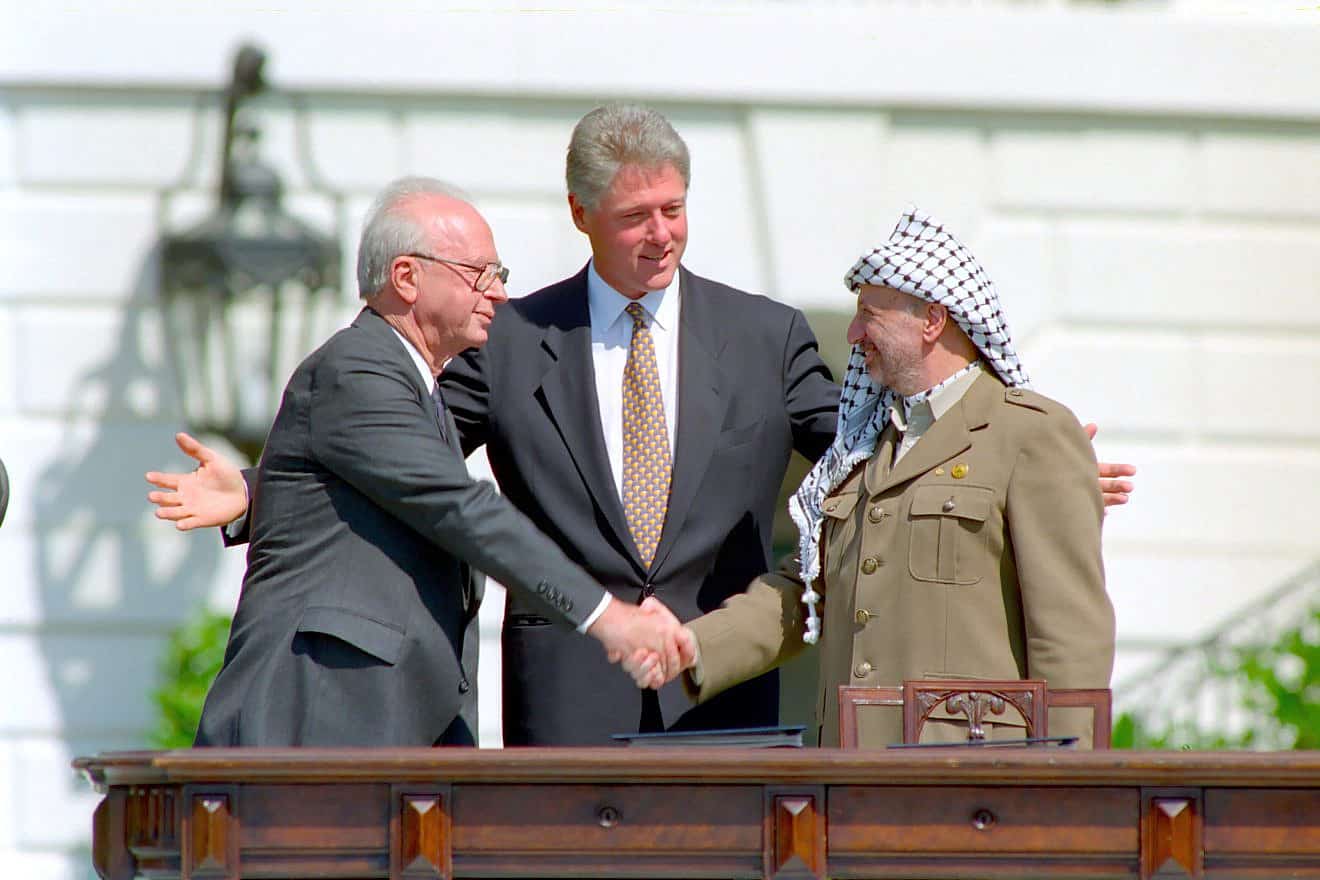
Signing of the Oslo accords in Washington, 13 September 1993. Vince Musi / White House, public domain. Archival photograph. — Vince Musi / The White House / Wikimedia Commons — domaine public, 13 septembre 1993.
Where things stand
As of 4 November 2026, the dossier contains 109 dated occurrences beginning in 1882. Following the ceasefire that took effect on 10 October 2025 and the release of the last twenty living Israeli hostages on 13 October, entries for October and November 2026 document continuing strikes and severe humanitarian difficulties in Gaza. Recent UN reports address displacement, access to health care and waste collection. Casualty figures remain attributed to their sources, with verification limits stated. The West Bank situation and regional developments require more detailed coverage.
Reported information
A year after the ceasefire, strikes and obstacles persist
On 10 October 2026, Associated Press reports that the agreement reached a year earlier has not ended strikes or delivered the full promised transition.
The previous day, more than one hundred humanitarian and rights organizations denounce what they call a ceasefire in name only. That assessment is attributed to them. Reduced major operations and hostage releases do not mean an end to violence, aid restrictions or the civilian crisis.
Security Council authorizes a Gaza stabilization force
On 17 November 2025, the Security Council adopts Resolution 2803, backing the Gaza plan and authorizing an international stabilization force.
The text establishes an international framework for the transition envisaged after the ceasefire. Legal authorization alone does not establish that a force has deployed or planned institutions are functioning. Their implementation requires separate verification.
Hamas releases the last twenty living Israeli hostages held in Gaza
The last twenty living Israeli hostages held in Gaza are released on 13 October 2025 under the ceasefire agreement.
The International Committee of the Red Cross facilitates their handover to Israeli authorities and the transfer of released Palestinian detainees to Gaza and the West Bank. The release follows the ceasefire’s entry into force on 10 October. It does not resolve the return of all deceased hostages’ remains, which involves separate operations.
On 10 October 2025, a ceasefire takes effect in Gaza following the agreement announced on 8 October and implementation terms signed on 9 October.
The agreement provides for Israeli redeployment, releases of hostages and Palestinian detainees, and aid entry. Israeli forces remain in a substantial part of the territory. Entry into force is distinct from full implementation and a durable political settlement.
On 22 September 2025, Emmanuel Macron announces at the UN that France recognizes the State of Palestine.
The decision comes during a conference co-chaired with Saudi Arabia to revive the two-state solution. It is French diplomatic recognition, without resolving borders, occupation or effective Palestinian sovereignty on the ground.
UN inquiry commission concludes genocide is occurring in Gaza
On 16 September 2025, the independent inquiry commission mandated by the Human Rights Council concludes that Israel is committing genocide against Palestinians in Gaza.
The report analyses acts and intent under the Genocide Convention. Israel rejects the findings. These are an inquiry commission’s conclusions, distinct from a final ICJ judgment or an individual criminal conviction.
On 22 August 2025, an IPC analysis confirms famine with reasonable evidence in Gaza Governorate as of mid-August.
This area classification does not mean every part of the Gaza Strip has exactly the same status. The report describes extreme hunger and malnutrition and projects risks of expansion. This entry distinguishes the dated finding from projections and subsequent assessments.
Israel resumes large-scale strikes, breaking the truce
On 18 March 2025, Israel launches large-scale strikes in Gaza, ending the pause established in January.
Palestinian health authorities report more than 400 killed in initial, attributed counts. Israel says it aims to compel Hamas to release hostages and relinquish power. Renewed fighting again exposes the population to displacement and disruption of relief.
On 2 March 2025, Israel halts aid and goods entry into Gaza after the first phase of the January ceasefire.
The government cites Hamas’s refusal to extend that phase under proposed terms. OCHA calls for reopening crossings. Closure precedes the resumption of large-scale strikes on 18 March: supply restrictions and military resumption are separate developments.
On 19 January 2025, a ceasefire agreement takes effect in Gaza after fifteen months of war.
It enables further releases of hostages and Palestinian prisoners and increased aid. Implementation is phased; entry into force guarantees neither completion of every phase nor a definitive end to hostilities.
ICC issues warrants for Netanyahu, Gallant and Deif
On 21 November 2024, the International Criminal Court issues arrest warrants for Benjamin Netanyahu, Yoav Gallant and Mohammed Deif.
Allegations concern war crimes and crimes against humanity in the conflict. The warrants rest on reasonable grounds to believe in criminal responsibility; they are not convictions. This entry records the decision at that date without presuming the later course of each proceeding.