Egypt · France · United Kingdom · Israel · Jordan · Lebanon · State of Palestine · Qatar · Saudi Arabia · Syrian Arab Republic · United States of America
File
Israeli–Palestinian conflict: from its origins to today
This dossier traces the modern origins and major stages of the Israeli–Palestinian conflict from the late nineteenth century to today: national movements, the British Mandate, Israel’s creation and the Nakba, wars, occupation and settlements, Palestinian mobilization, peace efforts, political divisions, humanitarian crises and international proceedings. Each published occurrence includes its sources and distinguishes established facts, attributed statements and judicial findings. The timeline needs further detail on local settlement developments, some regional episodes and negotiations; it does not claim to catalogue every incident.
Last updated : 109 key moments
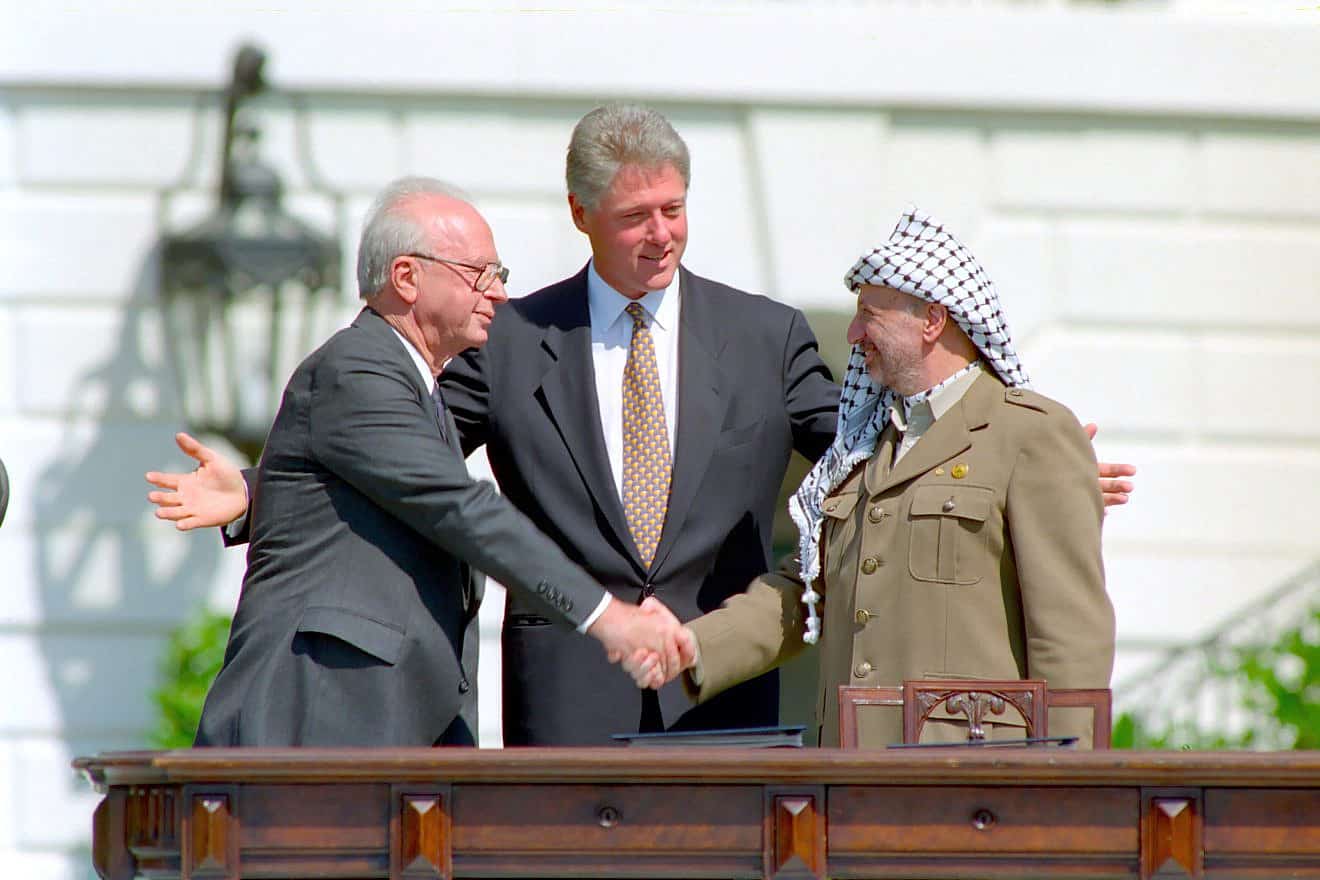
Signing of the Oslo accords in Washington, 13 September 1993. Vince Musi / White House, public domain. Archival photograph. — Vince Musi / The White House / Wikimedia Commons — domaine public, 13 septembre 1993.
Where things stand
As of 4 November 2026, the dossier contains 109 dated occurrences beginning in 1882. Following the ceasefire that took effect on 10 October 2025 and the release of the last twenty living Israeli hostages on 13 October, entries for October and November 2026 document continuing strikes and severe humanitarian difficulties in Gaza. Recent UN reports address displacement, access to health care and waste collection. Casualty figures remain attributed to their sources, with verification limits stated. The West Bank situation and regional developments require more detailed coverage.
Confirmed
Deir Yassin: Palestinian villagers massacred
On 9 April 1948, Irgun and Lehi forces attack Deir Yassin near Jerusalem and kill Palestinian inhabitants, including civilians.
ICRC delegate Jacques de Reynier enters the village on 11 April and describes bodies and survivors in his 13 April report. Early estimates differ and are not repeated here as a definitive death toll. This entry distinguishes the attack date from the humanitarian visit.
On 29 November 1947, the General Assembly adopts Resolution 181 (II), recommending Jewish and Arab states linked by an economic union.
Jerusalem is to have a special international regime. The Jewish leadership accepts the plan’s principle, while Palestinian Arab leaders reject it. The vote does not itself bring both states into existence; fighting intensifies in Palestine while it remains under the Mandate.
On 18 July 1947, British forces intercept Exodus, carrying more than 4,500 Jewish refugees, including Holocaust survivors, towards Palestine.
Passengers are subsequently sent back to Europe under British immigration restrictions. The episode exposes the plight of displaced people after the Nazi genocide. It occurs while the Mandate’s future and UN proposals are being debated.
On 22 July 1946, the underground Zionist organization Irgun bombs a wing of Jerusalem’s King David Hotel, killing more than 90 people.
The building houses Mandatory administration offices and British military headquarters. Civilians are among the victims. The bombing forms part of the armed campaign against continued British rule, before Britain takes the Palestine question to the United Nations.
On 17 May 1939, Britain publishes a new Palestine policy providing for 75,000 Jewish immigrants over five years, with subsequent immigration dependent on Arab agreement.
The White Paper envisages an independent state within ten years with Arabs and Jews sharing government, and provides for land restrictions. The Jewish Agency rejects the policy. The restrictions come as Nazi persecution makes finding refuge increasingly urgent.
The Peel Royal Commission report, issued on 7 July 1937, recommends partitioning Palestine following the violence of the Arab Revolt.
The proposal envisages Jewish and Arab states and an area remaining under British control, and considers population transfers. Palestinian leaders reject partition. This British proposal is distinct from the plan adopted by the UN General Assembly ten years later.
On 19 April 1936, an Arab national committee forms in Nablus and calls a strike amid deadly attacks and reprisals.
The movement spreads against British rule, Jewish immigration and land sales. An Arab Higher Committee is established on 25 April. The strike and subsequent armed rebellion continue in phases until 1939; British repression includes arrests, expulsions, demolitions and executions.
On 24 August 1929, Arab rioters attack Hebron’s Jewish community during a wave of violence spreading from Jerusalem.
The historical study in Die Welt des Islams records 67 community members killed. Survivors subsequently leave the city. The attacks form part of the 1929 clashes involving holy sites and political tensions under the Mandate; they are distinct from the massacre of Palestinian worshippers in Hebron in 1994.
On 24 July 1922, the League of Nations approves the mandate entrusted to Britain over Palestine.
The mandate incorporates support for a Jewish national home while requiring safeguards for all inhabitants’ civil and religious rights. It recognizes a role for a Jewish agency and provides for Jewish immigration and settlement. Approval is distinct from entry into force in September 1923.
On 1 May 1921, clashes involving rival Jewish marches in Jaffa develop into Arab attacks on Jews and wider violence.
The unrest spreads over subsequent days, killing Jews and Arabs. The Haycraft inquiry distinguishes the immediate trigger from underlying tensions over immigration and political projects. This distinction prevents reducing the episode to a dispute between processions.
San Remo assigns Britain responsibility for the Palestine mandate
On 25 April 1920, the Allied powers at San Remo decide to entrust Britain with the mandate over Palestine.
The decision incorporates the Jewish national home commitment and protection of non-Jewish communities’ rights. This political allocation precedes League of Nations approval of the mandate text in 1922 and its entry into force in 1923.