Egypt · France · United Kingdom · Israel · Jordan · Lebanon · State of Palestine · Qatar · Saudi Arabia · Syrian Arab Republic · United States of America
File
Israeli–Palestinian conflict: from its origins to today
This dossier traces the modern origins and major stages of the Israeli–Palestinian conflict from the late nineteenth century to today: national movements, the British Mandate, Israel’s creation and the Nakba, wars, occupation and settlements, Palestinian mobilization, peace efforts, political divisions, humanitarian crises and international proceedings. Each published occurrence includes its sources and distinguishes established facts, attributed statements and judicial findings. The timeline needs further detail on local settlement developments, some regional episodes and negotiations; it does not claim to catalogue every incident.
Last updated : 109 key moments
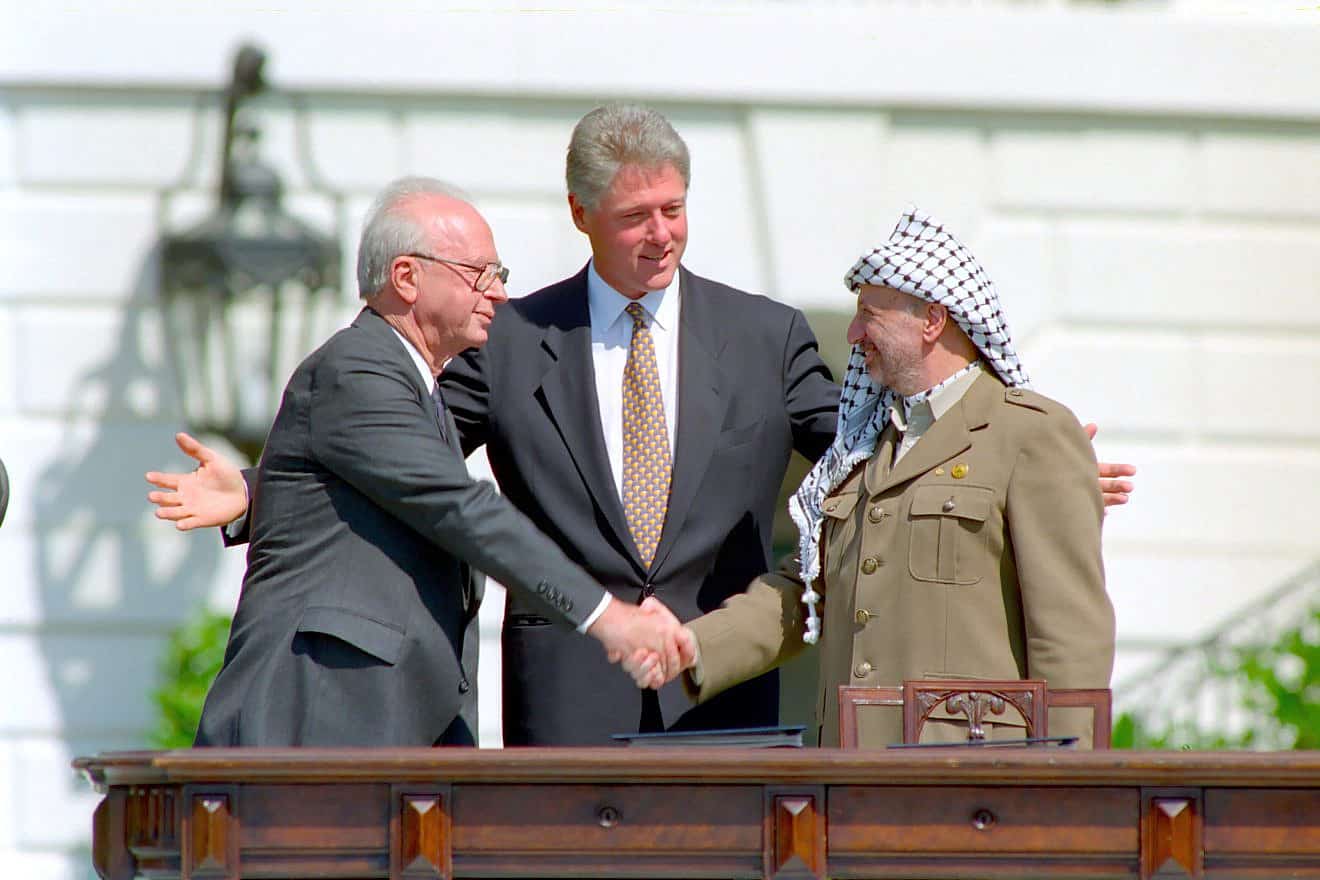
Signing of the Oslo accords in Washington, 13 September 1993. Vince Musi / White House, public domain. Archival photograph. — Vince Musi / The White House / Wikimedia Commons — domaine public, 13 septembre 1993.
Where things stand
As of 4 November 2026, the dossier contains 109 dated occurrences beginning in 1882. Following the ceasefire that took effect on 10 October 2025 and the release of the last twenty living Israeli hostages on 13 October, entries for October and November 2026 document continuing strikes and severe humanitarian difficulties in Gaza. Recent UN reports address displacement, access to health care and waste collection. Casualty figures remain attributed to their sources, with verification limits stated. The West Bank situation and regional developments require more detailed coverage.
Confirmed
Israel and PLO exchange recognition letters
On 9 September 1993, Yasser Arafat and Yitzhak Rabin exchange commitments ahead of the Oslo declaration’s signing.
The PLO recognizes Israel’s right to exist in peace and security and renounces terrorism. Israel recognizes the PLO as representative of the Palestinian people. This is not Israeli recognition of a Palestinian state.
On 30 October 1991, a peace conference opens in Madrid under US and Soviet sponsorship.
Israel meets Arab delegations and a joint Jordanian–Palestinian delegation. The PLO has no official seat. The conference opens bilateral and multilateral talks without itself producing an Israeli–Palestinian peace agreement.
National Council proclaims the State of Palestine in Algiers
On 15 November 1988, the Palestine National Council proclaims the State of Palestine during its Algiers session.
The declaration affirms the Palestinian people’s right to independence and invokes UN resolutions. The General Assembly acknowledges it on 15 December through Resolution 43/177. Proclamation and diplomatic recognition do not end occupation of the Palestinian territories.
King Hussein severs administrative ties with the West Bank
On 31 July 1988, King Hussein announces that Jordan is severing legal and administrative ties with the Israeli-occupied West Bank.
The decision abandons the option of Jordanian administration and strengthens the PLO’s place in Palestinian representation. It does not bring Israeli withdrawal. Hashemite responsibilities concerning holy sites are a separate issue.
On 14 December 1987, a communiqué announces the Islamic Resistance Movement, known as Hamas, during the first Intifada.
Emerging from the Palestinian Muslim Brotherhood and led notably by Ahmed Yassin, it develops an Islamist project and armed struggle distinct from the PLO. Its charter is issued in 1988; announcement, organization and adoption of the text are separate steps.
9 December 1987 is generally taken as the start of the first Intifada, after four Palestinian workers die in a collision with an Israeli military vehicle the previous day.
The uprising spreads from Jabaliya across Gaza and the West Bank. Demonstrations, strikes and clashes target Israeli occupation; repression brings deaths and arrests. Hamas emerges in the opening weeks, adding an Islamist actor distinct from the organizations grouped in the PLO.
From 16 to 18 September 1982, Lebanese Phalangist militiamen massacre Palestinian and Lebanese civilians in Beirut’s Sabra and Shatila.
The Israeli army controls the area following its invasion of Lebanon. In 1983, Israel’s Kahan Commission finds Israeli responsibility for failing to prevent the massacre and identifies personal responsibility on the part of Defence Minister Ariel Sharon. Victim estimates vary; no single total is adopted here.
Israel invades Lebanon and advances towards Beirut
On 6 June 1982, Israel launches a ground invasion of Lebanon against PLO and allied positions.
Presented as protecting northern Israel, the operation expands to Beirut. The siege and negotiations lead to PLO fighters’ departure during the summer. The fate of Palestinian civilians remaining in Lebanon becomes a major issue before the September massacres.
On 20 August 1980, the Security Council adopts Resolution 478 following Israel’s Basic Law proclaiming Jerusalem its complete and united capital.
The Council declares measures altering the city’s character and status null and void and calls for withdrawal of diplomatic missions located there. The decision reflects international opposition to annexation of East Jerusalem; it does not negotiate a settlement of its status.
On 26 March 1979, Egypt and Israel sign a peace treaty in Washington following the Camp David Accords.
It ends the state of war between them and provides for Israeli withdrawal from Sinai and diplomatic relations. The treaty changes the regional balance but is not a final-status agreement between Israel and the Palestinians.
Camp David sets a framework for peace and autonomy
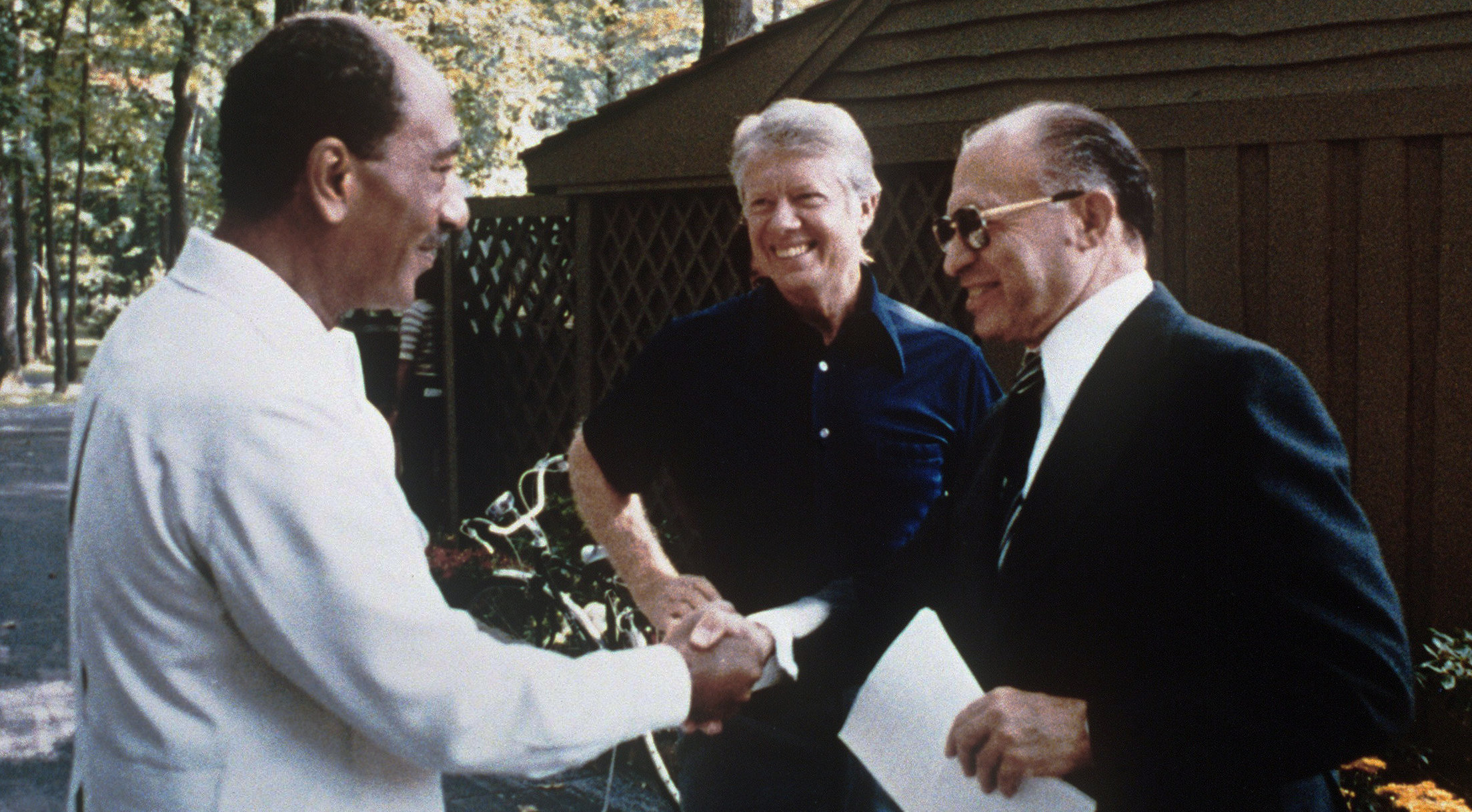
On 17 September 1978, Anwar Sadat and Menachem Begin conclude the Camp David Accords with Jimmy Carter’s mediation.
The three leaders at Camp David in September 1978. White House, public domain. — White House / Wikimedia Commons — domaine public, Camp David en septembre 1978.
The texts include a framework for Egyptian–Israeli peace and another for the Middle East, envisaging autonomy in the West Bank and Gaza. A bilateral treaty follows in March 1979. The Palestinian component does not deliver the envisaged comprehensive settlement.