
Skip to content
Egypt · France · United Kingdom · Israel · Jordan · Lebanon · State of Palestine · Qatar · Saudi Arabia · Syrian Arab Republic · United States of America
File

Israeli–Palestinian conflict: from its origins to today

This dossier traces the modern origins and major stages of the Israeli–Palestinian conflict from the late nineteenth century to today: national movements, the British Mandate, Israel’s creation and the Nakba, wars, occupation and settlements, Palestinian mobilization, peace efforts, political divisions, humanitarian crises and international proceedings. Each published occurrence includes its sources and distinguishes established facts, attributed statements and judicial findings. The timeline needs further detail on local settlement developments, some regional episodes and negotiations; it does not claim to catalogue every incident.

Last updated : 109 key moments

Where things stand

As of 4 November 2026, the dossier contains 109 dated occurrences beginning in 1882. Following the ceasefire that took effect on 10 October 2025 and the release of the last twenty living Israeli hostages on 13 October, entries for October and November 2026 document continuing strikes and severe humanitarian difficulties in Gaza. Recent UN reports address displacement, access to health care and waste collection. Casualty figures remain attributed to their sources, with verification limits stated. The West Bank situation and regional developments require more detailed coverage.

San Remo assigns Britain responsibility for the Palestine mandate

On 25 April 1920, the Allied powers at San Remo decide to entrust Britain with the mandate over Palestine.

The decision incorporates the Jewish national home commitment and protection of non-Jewish communities’ rights. This political allocation precedes League of Nations approval of the mandate text in 1922 and its entry into force in 1923.
Sources 2

Nabi Musa violence targets Jerusalem’s Jews

From 4 to 7 April 1920, violence erupts around Jerusalem’s Nabi Musa pilgrimage, including attacks on Jewish residents.

Britain’s Palin inquiry subsequently examines events, responsibility and political tensions. Violence occurs under British military administration before formal approval of the Mandate. It shows deteriorating communal relations amid competing national projects.

Sources 2

Britain backs a Jewish national home in Palestine

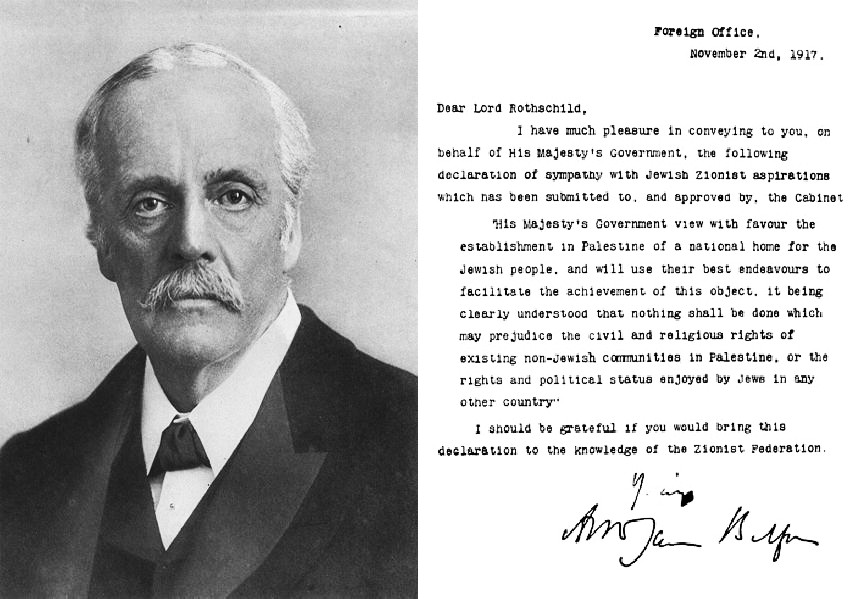
On 2 November 1917, Arthur Balfour sends Lord Rothschild a letter announcing British support for a national home for the Jewish people in Palestine.

Portrait of Balfour and text of his declaration.
Archival composite: Balfour’s portrait and the declaration of 2 November 1917. Public domain. — Portrait et déclaration Balfour / Wikimedia Commons, domaine public. Montage de documents anciens, 2008.

The text says the project must not prejudice the civil and religious rights of existing non-Jewish communities, or the rights and political status of Jews elsewhere. It neither creates a state nor defines its borders. The pledge becomes a central element of the British Mandate.

Sources 2

Sykes–Picot sets out spheres of influence in the Middle East

On 16 May 1916, a diplomatic exchange seals the secret Anglo-French Sykes–Picot agreement on the Ottoman Empire’s Arab territories.

The proposal envisages international administration in an area including much of Palestine. It is neither the Balfour Declaration nor the final drawing of all modern borders. Postwar decisions change its implementation.

Sources 2

Basel congress organizes the Zionist movement

The first Zionist Congress meets in Basel from 29 to 31 August 1897 at Theodor Herzl’s initiative.

Its programme seeks a home for the Jewish people in Palestine secured by public law. Establishing an organization gives the national project an international structure. This milestone marks neither the creation of Israel nor the beginning of all Jewish presence in Palestine.

Sources 2

Rishon LeZion illustrates the First Aliyah in Ottoman Palestine

On 31 July 1882, Jewish immigrants establish the agricultural settlement of Rishon LeZion in then-Ottoman Palestine.

The founding forms part of the First Aliyah, a migration wave linked to Eastern European pogroms and an emerging Jewish national project. It does not mark the beginning of all Jewish presence in the country. Migration and land changes later become issues in the modern conflict.

Sources 3