Egypt · France · United Kingdom · Israel · Jordan · Lebanon · State of Palestine · Qatar · Saudi Arabia · Syrian Arab Republic · United States of America
File
Israeli–Palestinian conflict: from its origins to today
This dossier traces the modern origins and major stages of the Israeli–Palestinian conflict from the late nineteenth century to today: national movements, the British Mandate, Israel’s creation and the Nakba, wars, occupation and settlements, Palestinian mobilization, peace efforts, political divisions, humanitarian crises and international proceedings. Each published occurrence includes its sources and distinguishes established facts, attributed statements and judicial findings. The timeline needs further detail on local settlement developments, some regional episodes and negotiations; it does not claim to catalogue every incident.
Last updated : 109 key moments
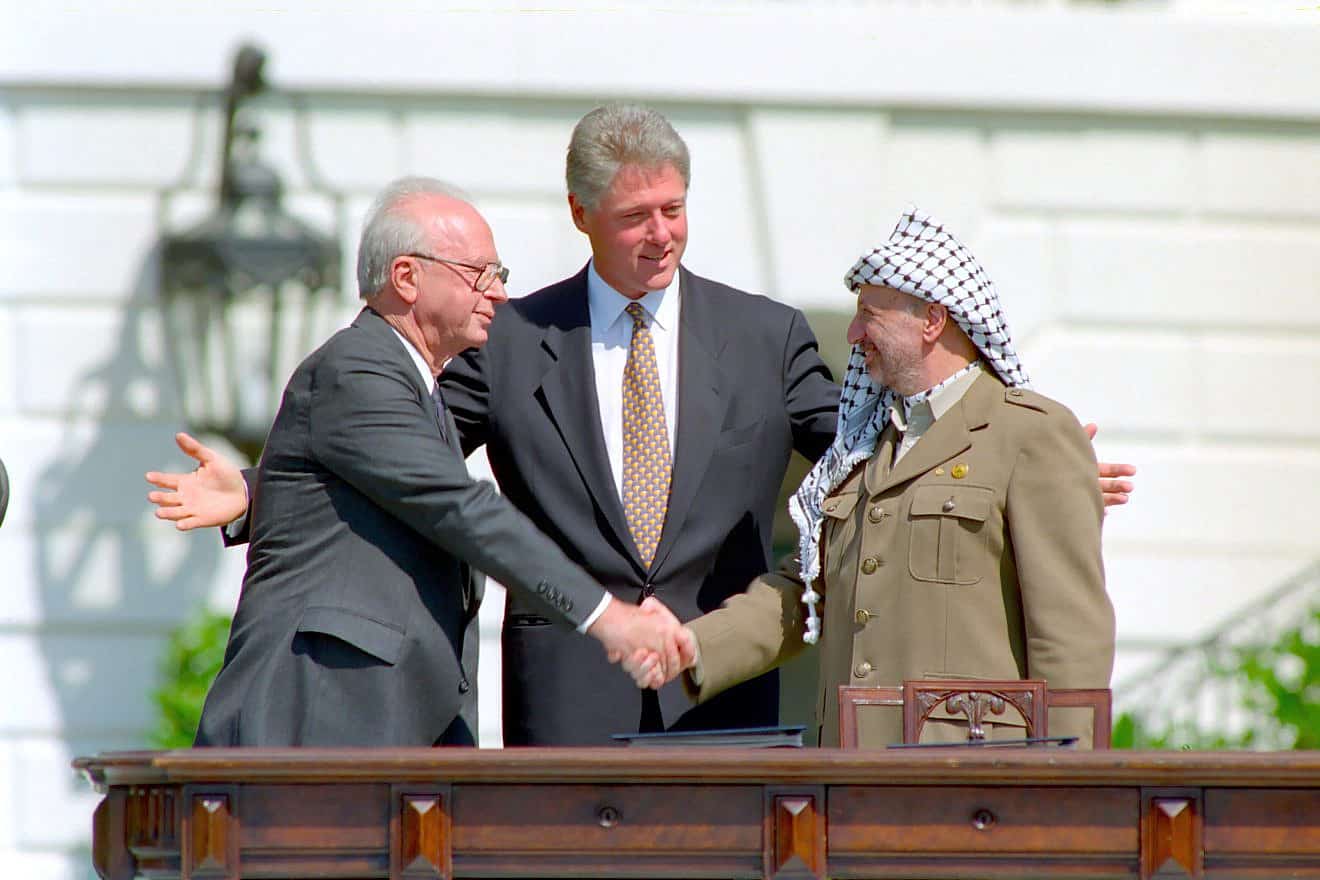
Signing of the Oslo accords in Washington, 13 September 1993. Vince Musi / White House, public domain. Archival photograph. — Vince Musi / The White House / Wikimedia Commons — domaine public, 13 septembre 1993.
Where things stand
As of 4 November 2026, the dossier contains 109 dated occurrences beginning in 1882. Following the ceasefire that took effect on 10 October 2025 and the release of the last twenty living Israeli hostages on 13 October, entries for October and November 2026 document continuing strikes and severe humanitarian difficulties in Gaza. Recent UN reports address displacement, access to health care and waste collection. Casualty figures remain attributed to their sources, with verification limits stated. The West Bank situation and regional developments require more detailed coverage.
Confirmed
Resolution 2334 demands an end to settlement activity
On 23 December 2016, the Security Council adopts Resolution 2334, with the United States abstaining.
The text states that Israeli settlements in territory occupied since 1967, including East Jerusalem, have no legal validity and demands an end to settlement activity. Adoption establishes the Council’s position; it does not show that settlement activity actually stopped.
On 1 April 2015, Palestine becomes the 123rd state party to the Rome Statute, the International Criminal Court’s founding treaty.
Accession brings international criminal justice rights and obligations. A separate declaration accepts Court jurisdiction from 13 June 2014. Membership does not automatically produce an investigation, warrant or conviction.
On 26 August 2014, an Egyptian-mediated ceasefire ends the main phase of hostilities in Gaza and Israel.
The July–August campaign includes Israeli strikes and a ground offensive as well as Palestinian rocket and mortar fire. OCHA describes extensive civilian losses and destruction in Gaza. Ending the fighting does not resolve access and reconstruction issues.
On 29 November 2012, the General Assembly grants Palestine non-member observer state status through Resolution 67/19.
The vote is 138 in favour, nine against and 41 abstentions. The decision upgrades its international status without admission to full UN membership or an end to occupation.
On 21 November 2012, Israel and Hamas accept an Egyptian-mediated ceasefire after eight days of hostilities.
Escalation from 14 to 21 November includes Israeli strikes in Gaza and rocket fire towards Israel. The truce ends this round of fighting without resolving the blockade, Palestinian division or the underlying conflict.
On 31 October 2011, UNESCO’s General Conference votes to admit Palestine by 107 votes to 14, with 52 abstentions.
Membership then requires the prescribed constitutional formalities. The step strengthens Palestinian international representation in education, science and culture. It is distinct from the status granted by the UN General Assembly in 2012.
On 18 October 2011, Gilad Shalit is freed after more than five years in Gaza in the first stage of an exchange negotiated by Israel and Hamas.
The agreement provides for a total of 1,027 Palestinian prisoners to be released in stages. Releases that day are distinct from this planned total. Amnesty International recalls the parties’ obligations concerning detention conditions and treatment.
On 31 May 2010, Israeli forces intercept a flotilla heading to Gaza at sea; nine Mavi Marmara passengers die during the operation.
The ships seek to challenge the blockade and deliver relief. The boarding and use of force become subjects of inquiries with differing legal assessments. Nine refers to deaths during the operation, before an injured passenger’s later death.
On 27 December 2008, Israel launches a major air campaign in Gaza, followed by a ground offensive in January 2009.
Hostilities include Palestinian rocket fire towards Israel and cause heavy casualties and destruction in Gaza. Unilateral ceasefires are announced on 18 January 2009. Later investigations examine the conduct of different parties; their findings require attribution.
On 27 November 2007, Ehud Olmert and Mahmoud Abbas adopt a joint understanding in Annapolis to relaunch negotiations under George W. Bush’s sponsorship.
The parties set out the goal of a treaty and a two-state solution. The conference follows the rupture between Gaza and the West Bank. A commitment to negotiate is not a concluded peace agreement.
On 14 June 2007, Hamas forces capture the main Palestinian Authority security headquarters in Gaza after days of fighting with Fatah.
The rupture creates separate Palestinian centres of power in Gaza and the West Bank. Israel imposes a land, sea and air blockade, citing security; access restrictions predate June and intensify that month. Civilians bear the consequences of the prolonged closure.