Egypt · France · United Kingdom · Israel · Jordan · Lebanon · State of Palestine · Qatar · Saudi Arabia · Syrian Arab Republic · United States of America
File
Israeli–Palestinian conflict: from its origins to today
This dossier traces the modern origins and major stages of the Israeli–Palestinian conflict from the late nineteenth century to today: national movements, the British Mandate, Israel’s creation and the Nakba, wars, occupation and settlements, Palestinian mobilization, peace efforts, political divisions, humanitarian crises and international proceedings. Each published occurrence includes its sources and distinguishes established facts, attributed statements and judicial findings. The timeline needs further detail on local settlement developments, some regional episodes and negotiations; it does not claim to catalogue every incident.
Last updated : 109 key moments
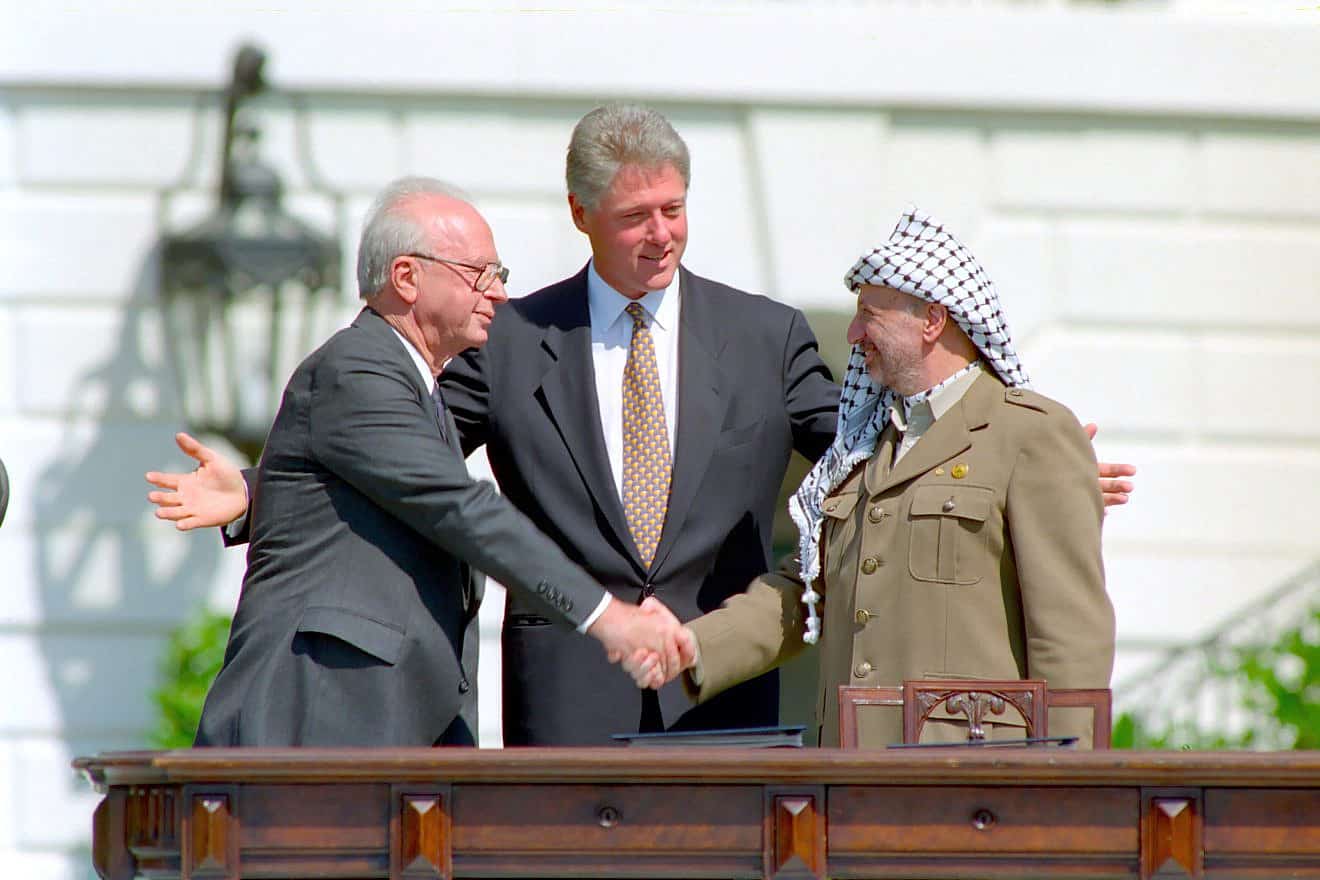
Signing of the Oslo accords in Washington, 13 September 1993. Vince Musi / White House, public domain. Archival photograph. — Vince Musi / The White House / Wikimedia Commons — domaine public, 13 septembre 1993.
Where things stand
As of 4 November 2026, the dossier contains 109 dated occurrences beginning in 1882. Following the ceasefire that took effect on 10 October 2025 and the release of the last twenty living Israeli hostages on 13 October, entries for October and November 2026 document continuing strikes and severe humanitarian difficulties in Gaza. Recent UN reports address displacement, access to health care and waste collection. Casualty figures remain attributed to their sources, with verification limits stated. The West Bank situation and regional developments require more detailed coverage.
Confirmed
Gaza ceasefire takes effect in January 2025
On 19 January 2025, a ceasefire agreement takes effect in Gaza after fifteen months of war.
It enables further releases of hostages and Palestinian prisoners and increased aid. Implementation is phased; entry into force guarantees neither completion of every phase nor a definitive end to hostilities.
ICC issues warrants for Netanyahu, Gallant and Deif
On 21 November 2024, the International Criminal Court issues arrest warrants for Benjamin Netanyahu, Yoav Gallant and Mohammed Deif.
Allegations concern war crimes and crimes against humanity in the conflict. The warrants rest on reasonable grounds to believe in criminal responsibility; they are not convictions. This entry records the decision at that date without presuming the later course of each proceeding.
ICJ finds Israel’s continued presence in occupied territory unlawful
On 19 July 2024, the ICJ concludes in an advisory opinion that Israel’s continued presence in occupied Palestinian territory is unlawful and must end as rapidly as possible.
The ICJ’s seat, photographed on 7 August 2024. Illustration; not the hearing. CIRISORG, CC BY-SA 4.0. — CIRISORG / Wikimedia Commons — CC BY-SA 4.0 https://creativecommons.org/licenses/by-sa/4.0/ ; 7 août 2024, redimensionnement.
The Court examines annexation, settlement and Palestinians’ right to self-determination. The opinion is separate from the Gaza genocide proceedings and individual prosecutions before the ICC. Israel rejects its findings.
On 24 May 2024, the ICJ orders Israel to halt immediately its offensive and any other action in Rafah that may impose conditions bringing about the physical destruction of Palestinians in Gaza, in whole or in part.
The ICJ’s seat, photographed on 7 August 2024. Illustration; not the hearing. CIRISORG, CC BY-SA 4.0. — CIRISORG / Wikimedia Commons — CC BY-SA 4.0 https://creativecommons.org/licenses/by-sa/4.0/ ; 7 août 2024, redimensionnement.
The order also requires keeping the Rafah crossing open for urgently needed assistance at scale. It strengthens provisional measures in South Africa v. Israel; it is not a merits judgment on genocide.
On 7 May 2024, the Israeli army takes control of the Gaza side of the Rafah crossing on the Egyptian border during its offensive in the area.
The UN reports the crossing closed to people and goods. Civilian displacement and obstacles to aid and fuel entry worsen the humanitarian crisis. Taking the crossing does not establish that the whole city is then under Israeli control.
Israeli strikes kill seven World Central Kitchen aid workers
On 1 April 2024, Israeli strikes kill seven World Central Kitchen team members working on an aid delivery mission in Gaza.
The organization suspends operations and announces their resumption on 28 April. The attack and subsequent investigations raise questions about protection of humanitarian convoys. Australia’s special adviser report examines Israel’s response; it is not an international criminal judgment.
On 25 March 2024, the Security Council adopts Resolution 2728 demanding an immediate Ramadan ceasefire leading to a lasting truce.
The text also demands immediate and unconditional hostage release and humanitarian access. The United States abstains. This international demand must not be presented as evidence that fighting actually stopped.
ICJ orders provisional measures in the genocide case
On 26 January 2024, the International Court of Justice orders provisional measures against Israel in South Africa’s case under the Genocide Convention.
The ICJ’s seat, photographed on 7 August 2024. Illustration; not the hearing. CIRISORG, CC BY-SA 4.0. — CIRISORG / Wikimedia Commons — CC BY-SA 4.0 https://creativecommons.org/licenses/by-sa/4.0/ ; 7 août 2024, redimensionnement.
The order addresses prevention of prohibited acts, punishment of incitement and improved humanitarian assistance. It does not decide whether genocide has occurred and does not at this stage order the general ceasefire requested. Israel disputes the allegations.
November truce enables the first negotiated exchanges
On 24 November 2023, a pause in fighting begins in Gaza, enabling releases of hostages held by Hamas and other groups and Palestinian prisoners held by Israel.
The ICRC acts as a neutral intermediary for transfers. Foreign nationals are also released. The agreement opens a humanitarian window, but this temporary pause does not end the war.
Israel expands ground operations in the Gaza Strip
The Israeli military announces an expansion of its ground operations in Gaza on 27 October 2023, following several limited incursions.
Troops sent in that evening remain in the field the next day as bombardment intensifies and communications go down. On 28 October, Benjamin Netanyahu describes the offensive as a second phase of the war, aimed at Hamas’s military and governing capabilities and the return of hostages. Humanitarian agencies struggle to contact their teams.
On 9 October 2023, Israeli Defence Minister Yoav Gallant announces a complete siege of Gaza, halting supplies during the military campaign launched after the 7 October attacks.
OCHA reports the announced cutoff of electricity, fuel, food and water. Bombardment and displacement increase protection and relief needs. The announcement is distinct from the blockade imposed in 2007 and tightens an already highly restricted situation.