Egypt · France · United Kingdom · Israel · Jordan · Lebanon · State of Palestine · Qatar · Saudi Arabia · Syrian Arab Republic · United States of America
File
Israeli–Palestinian conflict: from its origins to today
This dossier traces the modern origins and major stages of the Israeli–Palestinian conflict from the late nineteenth century to today: national movements, the British Mandate, Israel’s creation and the Nakba, wars, occupation and settlements, Palestinian mobilization, peace efforts, political divisions, humanitarian crises and international proceedings. Each published occurrence includes its sources and distinguishes established facts, attributed statements and judicial findings. The timeline needs further detail on local settlement developments, some regional episodes and negotiations; it does not claim to catalogue every incident.
Last updated : 109 key moments
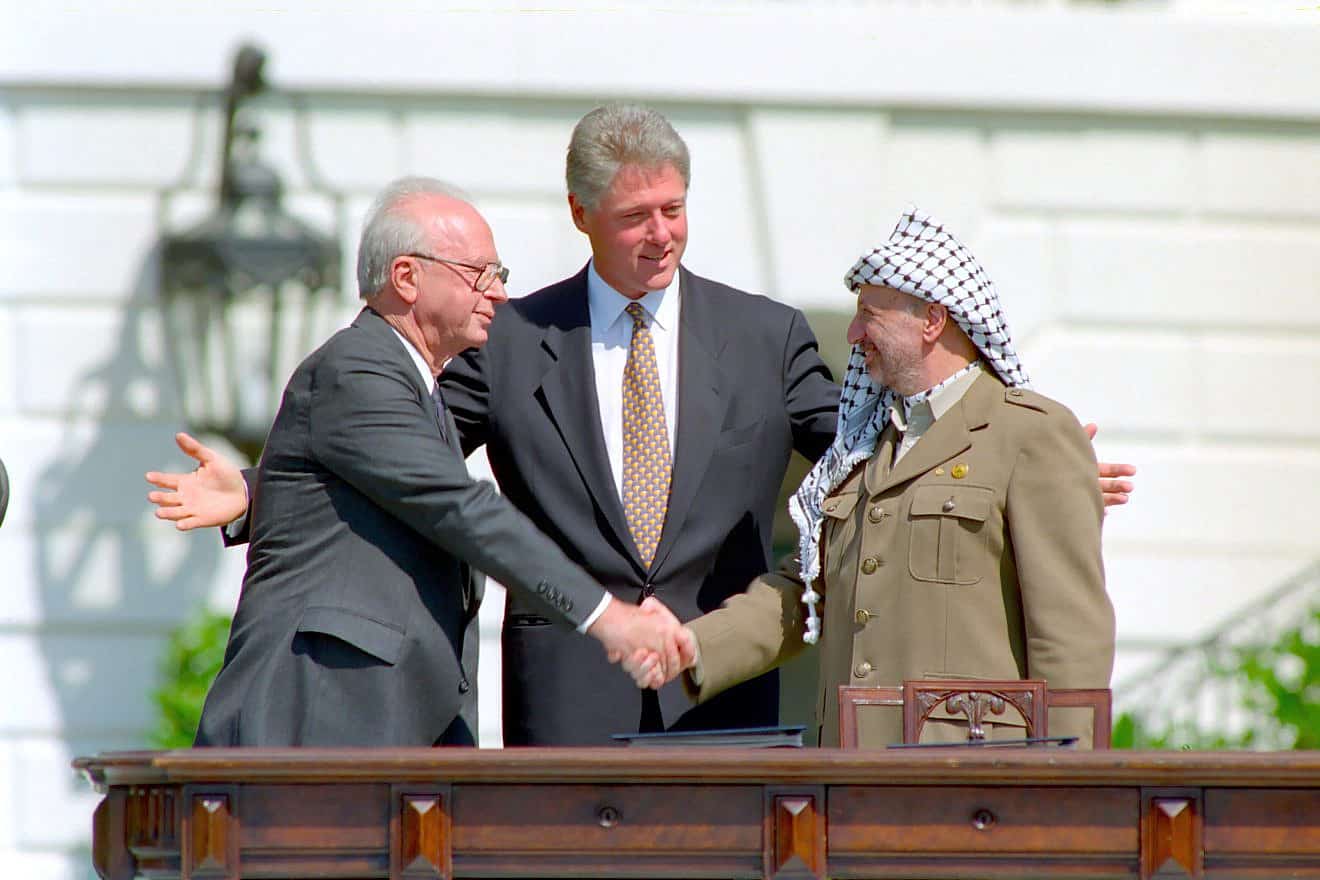
Signing of the Oslo accords in Washington, 13 September 1993. Vince Musi / White House, public domain. Archival photograph. — Vince Musi / The White House / Wikimedia Commons — domaine public, 13 septembre 1993.
Where things stand
As of 4 November 2026, the dossier contains 109 dated occurrences beginning in 1882. Following the ceasefire that took effect on 10 October 2025 and the release of the last twenty living Israeli hostages on 13 October, entries for October and November 2026 document continuing strikes and severe humanitarian difficulties in Gaza. Recent UN reports address displacement, access to health care and waste collection. Casualty figures remain attributed to their sources, with verification limits stated. The West Bank situation and regional developments require more detailed coverage.
Confirmed
Gilad Shalit freed in a prisoner exchange
On 18 October 2011, Gilad Shalit is freed after more than five years in Gaza in the first stage of an exchange negotiated by Israel and Hamas.
The agreement provides for a total of 1,027 Palestinian prisoners to be released in stages. Releases that day are distinct from this planned total. Amnesty International recalls the parties’ obligations concerning detention conditions and treatment.
On 31 May 2010, Israeli forces intercept a flotilla heading to Gaza at sea; nine Mavi Marmara passengers die during the operation.
The ships seek to challenge the blockade and deliver relief. The boarding and use of force become subjects of inquiries with differing legal assessments. Nine refers to deaths during the operation, before an injured passenger’s later death.
On 27 December 2008, Israel launches a major air campaign in Gaza, followed by a ground offensive in January 2009.
Hostilities include Palestinian rocket fire towards Israel and cause heavy casualties and destruction in Gaza. Unilateral ceasefires are announced on 18 January 2009. Later investigations examine the conduct of different parties; their findings require attribution.
On 27 November 2007, Ehud Olmert and Mahmoud Abbas adopt a joint understanding in Annapolis to relaunch negotiations under George W. Bush’s sponsorship.
The parties set out the goal of a treaty and a two-state solution. The conference follows the rupture between Gaza and the West Bank. A commitment to negotiate is not a concluded peace agreement.
On 14 June 2007, Hamas forces capture the main Palestinian Authority security headquarters in Gaza after days of fighting with Fatah.
The rupture creates separate Palestinian centres of power in Gaza and the West Bank. Israel imposes a land, sea and air blockade, citing security; access restrictions predate June and intensify that month. Civilians bear the consequences of the prolonged closure.
On 25 June 2006, Palestinian fighters from Gaza attack a military post and tank near Kerem Shalom and capture Israeli soldier Gilad Shalit.
He is taken to Gaza and held for more than five years without ICRC access. His capture becomes central to military operations and prisoner negotiations. He is released in an exchange in October 2011.
The 25 January 2006 election gives Hamas, running as Change and Reform, a majority with 74 of the Legislative Council’s 132 seats.
Voting covers the West Bank and Gaza. Victory opens a new phase of institutional rivalry with Fatah; it is not yet exclusive control over Gaza, which follows in 2007.
Israel completes withdrawal of permanent installations from Gaza
On 12 September 2005, the last Israeli forces leave Gaza under the disengagement plan following evacuation of the settlements.
Withdrawal changes the form of Israeli control. It is distinct from Hamas’s takeover in 2007. Whether occupation continues in law under effective control is a separate question from the physical departure of troops and settlers.
Yasser Arafat’s death opens Palestinian succession
On 11 November 2004, Yasser Arafat dies in a military hospital near Paris after leading the PLO and Palestinian Authority.
His death opens separate successions in Palestinian institutions. It comes as the second Intifada and Israeli restrictions have severely weakened the Oslo process. This entry does not resolve later controversies over the cause of death.
ICJ finds wall built in occupied territory unlawful
On 9 July 2004, the International Court of Justice delivers its advisory opinion on the wall Israel is building in occupied Palestinian territory.
The Court finds its construction and associated regime there contrary to international law. The opinion concerns the route in occupied territory, including around East Jerusalem. It is an advisory opinion, distinct from a criminal judgment against individuals.
On 30 April 2003, the Quartet presents Israel and the Palestinian Authority with a roadmap towards a two-state solution.
The plan combines political, security, humanitarian and institutional steps and initially targets a settlement in 2005. Its deadlines are announced goals, not achieved outcomes. It sets reciprocal obligations, including on violence and settlement activity.