
Skip to content
South Africa
File

South Africa: November 2026 local elections

Published Updated

This dossier follows South Africa’s municipal vote, results and formation of local executives. It distinguishes provisional tallies, voters’ perceptions and officially established results.

Latest event : 7 key moments

Where things stand

As of 6 November 2026, partial tallies put the ANC near one third of votes and coalition formation remains open. The HSRC has also released its voter-experience survey, separate from the results.

South African local elections: ANC stays near one third as counting progresses

Provisional results from South Africa’s 4 November local elections showed a sharp ANC decline on 6 November 2026. At 11:30 GMT, Reuters put it at 32% against 25% for the Democratic Alliance, with 81% of votes counted.
Flag of South Africa.
South African flag, October 2008. File illustration; does not depict the election. Chris Eason, CC BY 2.0, unmodified. — Chris Eason / Wikimedia Commons — CC BY 2.0 https://creativecommons.org/licenses/by/2.0/ — 31 octobre 2008 ; sans modification.

An earlier tally cited by Associated Press put the ANC near 31% with 76% counted. These snapshots come from different stages of counting; they are neither a final declaration nor the final allocation of municipal seats.

The party won just over 45% nationally in the 2021 local elections. The immediate question concerns coalitions governing major cities, including Johannesburg and eThekwini, where outcomes remained unsettled in the reports reviewed.

Councils manage services including water, road maintenance and rubbish collection. The ANC acknowledges losing support, AP reports. The composition of local executives will depend on the complete results and subsequent agreements between parties.
Sources 2

South Africa: HSRC releases survey of 13,198 voters

The Human Sciences Research Council presented its survey of voters’ experience in South Africa’s 4 November local elections on 6 November 2026. According to findings reported by SAnews, 91% of respondents said they waited no longer than thirty minutes to vote.

Flag of South Africa.
South African flag, October 2008. File illustration; does not depict the election. Chris Eason, CC BY 2.0, unmodified. — Chris Eason / Wikimedia Commons — CC BY 2.0 https://creativecommons.org/licenses/by/2.0/ — 31 octobre 2008 ; sans modification.

Researchers interviewed 13,198 people at 300 voting stations across all nine provinces, selecting voters throughout the day. The study measures the perceptions and experience of people who voted: it does not by itself explain abstention or replace the vote count.

Among respondents, 90% regarded procedures as free and 91% as fair. Reported trust in the Electoral Commission stood at 81%, compared with 85% in 2024, according to the same research body. These are survey estimates, rather than certification of every electoral operation.

The HSRC identified issues requiring attention around perceived impartiality, information and inclusion. Satisfaction findings can inform election administration without settling an individual objection or determining a party’s seats.

Sources 3

South African local elections: ANC loses ground in early partial results

Early results from South Africa’s municipal elections, released on 5 November 2026, put the ANC at around 32% of votes in a still very incomplete count. Reuters and Daily Maverick describe declining support for the party, but no final national outcome can be inferred.

South African flag photographed in October 2008. Illustrative archive photograph. Chris Eason, CC BY 2.0; unchanged.
South African flag photographed in October 2008. Illustrative archive photograph. Chris Eason, CC BY 2.0; unchanged. — Chris Eason / Wikimedia Commons — CC BY 2.0 https://creativecommons.org/licenses/by/2.0/ — 31 octobre 2008 ; sans modification.

In Reuters’ early-morning snapshot, about 12% of votes had been counted: the ANC had roughly 32%, against around 30% for the Democratic Alliance. These percentages describe a specific stage of counting, not the final distribution.

Daily Maverick reports difficulties for the ANC in urban and rural municipalities. National chairperson Gwede Mantashe nevertheless says conclusions are premature, with several areas still outstanding. The formation of councils will depend on complete results and, where needed, agreements between parties.

Sources 3

South Africans vote in local elections as public services dominate concerns

South Africans voted on 4 November 2026 to renew their local councils. Access to water, electricity and maintained infrastructure dominates concerns described in reporting by Africanews and TV5MONDE.

South African flag photographed in October 2008.
2008 archive image; does not show the 2026 vote. Chris Eason, CC BY 2.0; unchanged. — Chris Eason / Wikimedia Commons — CC BY 2.0 https://creativecommons.org/licenses/by/2.0/ — 31 octobre 2008 ; sans modification.

The election covers eight metropolitan municipalities, 44 district councils and 205 local councils. In Johannesburg, failures in municipal services have focused criticism on incumbent leaders.

The vote is another test for the African National Congress as its support has declined. Cyril Ramaphosa voted in Johannesburg. Observations from election day do not establish a winner: the sources consulted provide no final results.

Sources 2

South Africa ends special voting, reports 1.43 million participants

Special voting for South Africa’s municipal elections ended on 3 November 2026. The Electoral Commission reports a preliminary count of 1,425,942 voters over 2–3 November, ahead of the main vote on 4 November.

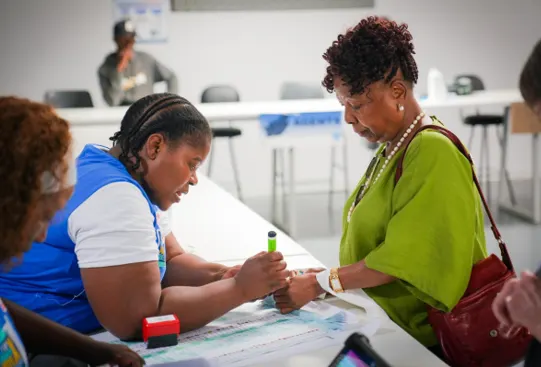
Photograph published by SAnews with its 3 November 2026 special-voting report. Credit: SAnews / GCIS; reuse permitted with credit.
Photograph published by SAnews with its 3 November 2026 special-voting report. Credit: SAnews / GCIS; reuse permitted with credit. — SAnews / GCIS — reproduction autorisée avec crédit : https://www.sanews.gov.za/node/85408 ; aucune modification.

SAnews reports the figure announced by Commission Chairperson Mosotho Moepya. It counts people who voted, distinct from the roughly 2.6 million approved special-vote applications.

Voting took place at stations and through home visits. Channel Africa also describes the completion of this advance phase.

Ballots are stored for counting with those from the main election after stations close. This participation count is therefore no election result or indication of a party’s victory.

Sources 2

South Africa: special voting begins ahead of 4 November local elections

Special voting in South Africa’s municipal elections began on 2 November 2026 and continues on 3 November. SABC and Eyewitness News report voting-station operations and home visits ahead of the general poll on 4 November.

South African flag, October 2008. Archive image; not the 2026 vote. Chris Eason, CC BY 2.0.
South African flag, October 2008. Archive image; not the 2026 vote. Chris Eason, CC BY 2.0. — Chris Eason / Wikimedia Commons — CC BY 2.0 https://creativecommons.org/licenses/by/2.0/ — 31 octobre 2008 ; sans modification.

The IEC approved more than 2.6 million applications. This is the number authorised to vote early, rather than a count of ballots already cast.

In Durban, EWN describes more than fifty older people voting at a TAFTA centre. Special ballots are to be stored and counted with other votes after general polling closes, under arrangements reported by Scrolla.

Sources 3

South African local elections: over 2.6 million approved for special voting

South Africa’s Electoral Commission (IEC) said on 1 November 2026 that over 2.6 million voters were approved for special voting on 2 and 3 November. The main local election is scheduled for 4 November.

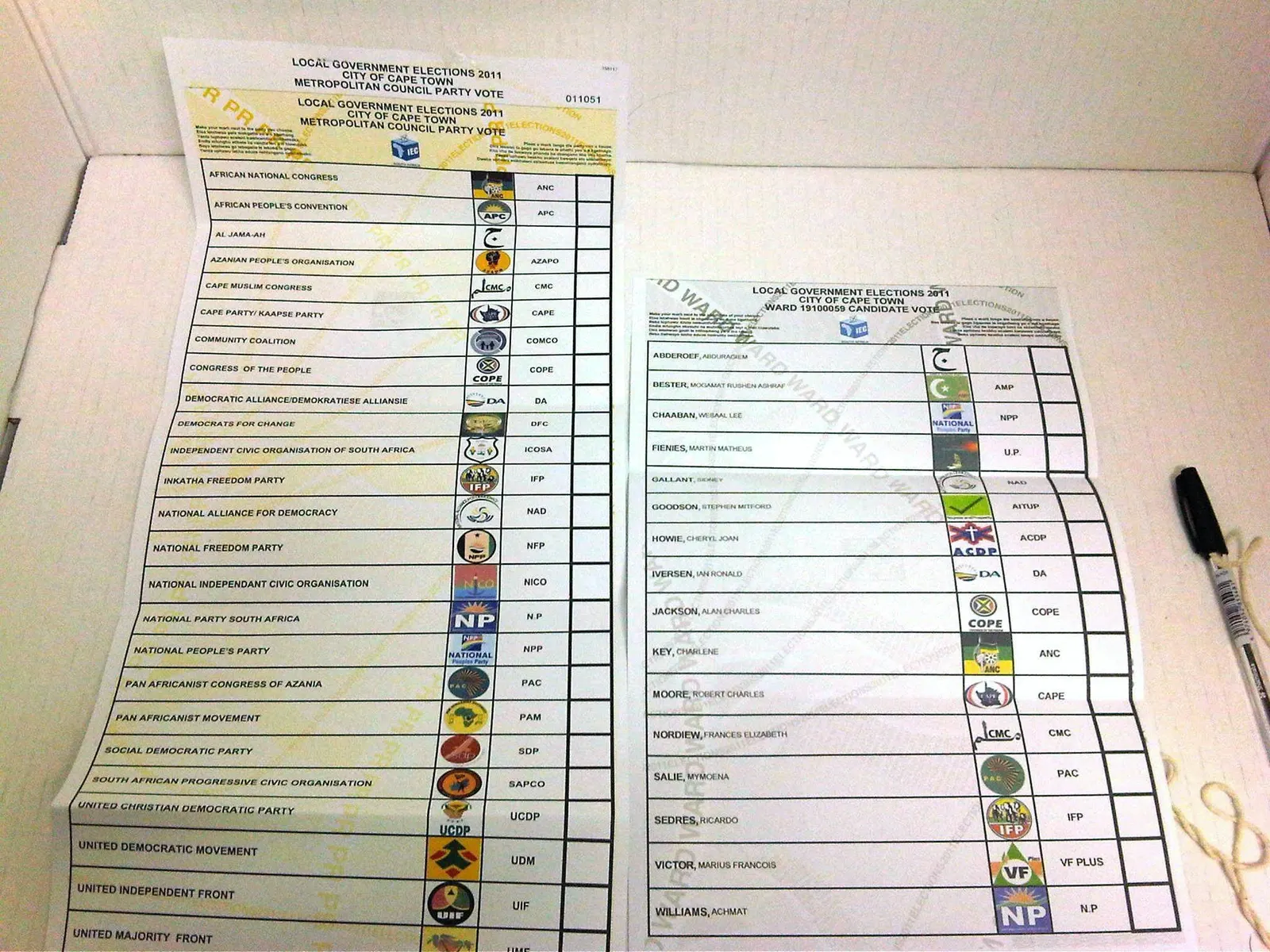
South African local election ballots from May 2011; archive illustration, not 2026 ballots. Discott, CC BY-SA 3.0; colour adjusted by JMK in 2021.
South African local election ballots from May 2011; archive illustration, not 2026 ballots. Discott, CC BY-SA 3.0; colour adjusted by JMK in 2021. — Discott / Wikimedia Commons — CC BY-SA 3.0 https://creativecommons.org/licenses/by-sa/3.0/ — 18 mai 2011 ; couleurs ajustées par JMK en 2021.

Chief Electoral Officer Sy Mamabolo spoke at the national results centre in Midrand, SABC reports. He urged people approved for home visits to remain at the address supplied in their application.

The total refers to approved special-voting applications, not turnout already recorded. Voting and its results were still ahead when the announcement was made.

Sources 2