Seoul briefly suspends program selling as KOSPI falls
Korea Exchange triggered a temporary suspension of program selling on the KOSPI market at 10:16 a.m. Seoul time on 5 November 2026, Money Today reports. Shares continued to fall during morning trading, according to SBS.
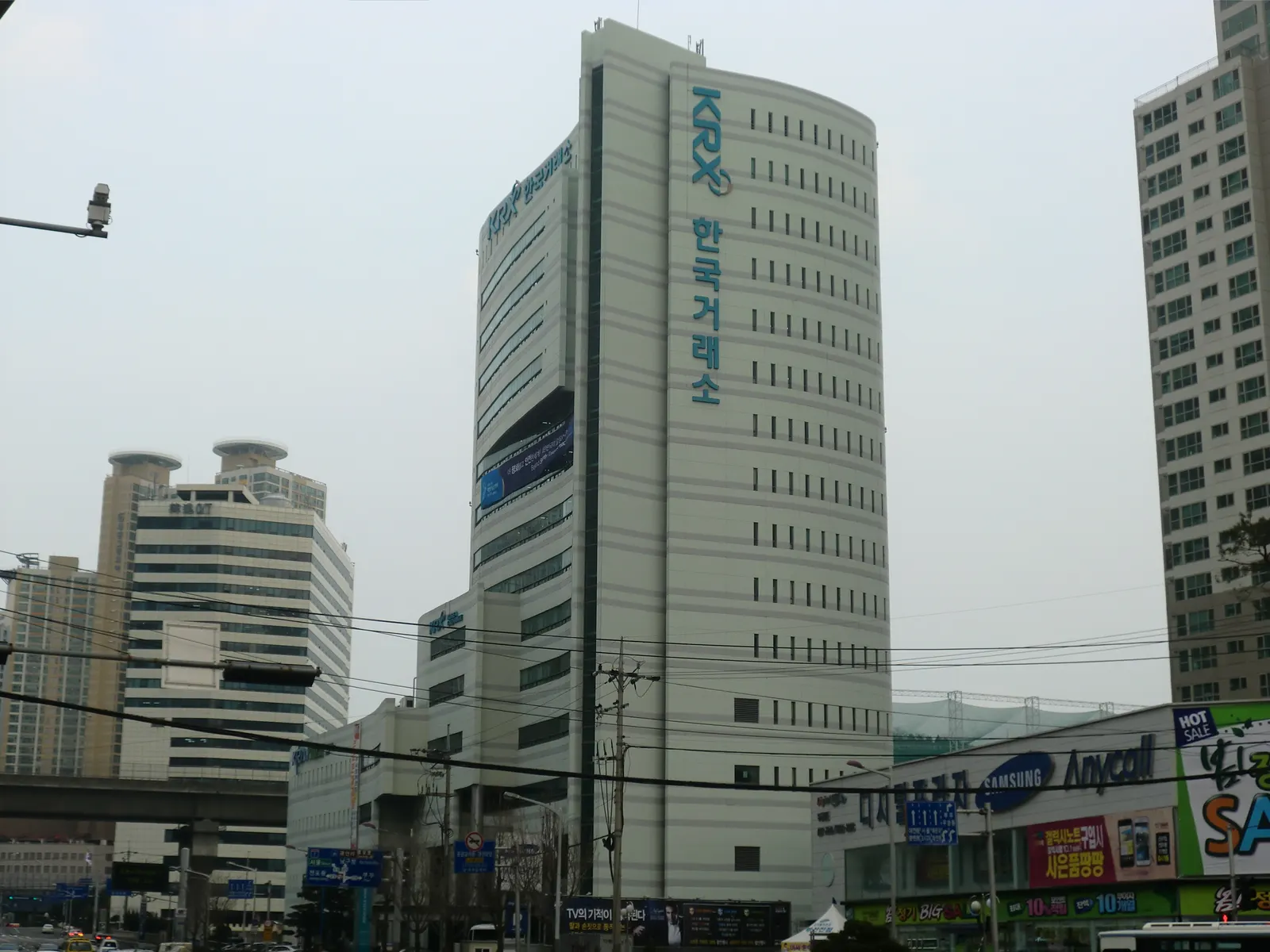
Korea Exchange in Busan, 7 March 2012. Archive; does not depict the 2026 session. Hyolee2, CC BY-SA 3.0; unmodified. — Hyolee2 / Wikimedia Commons — CC BY-SA 3.0 https://creativecommons.org/licenses/by-sa/3.0/ — 7 mars 2012, sans modification.
The “sidecar” mechanism suspends the effect of program sell orders for five minutes when KOSPI 200 futures fall at least 5% for one minute. It applies to those orders rather than halting all trading.
In its late-morning bulletin, SBS described a KOSPI decline of nearly 5%, with semiconductor shares falling sharply. The broadcaster linked investor concerns to possible tighter US rules on AI data centres; that is an interpretation of market movements.
These figures describe an ongoing session. They are not the closing level for 5 November.
South Korea’s KOSPI closed on 2 November 2026 at 5,859.08, gaining 128.34 points, or 2.24%. It recovered part of the previous session’s decline.
Korea Exchange in Busan, March 2012. Archive image; does not show the 2 November 2026 session. Hyolee2, CC BY-SA 3.0. — Hyolee2 / Wikimedia Commons — CC BY-SA 3.0 https://creativecommons.org/licenses/by-sa/3.0/ — 7 mars 2012, sans modification.
The session nevertheless began lower and the index touched a low of 5,616.50. Samsung Electronics finished up 1.78% and SK hynix rose 3.81%, according to Aju Press.
Aju Press attributes the recovery to institutional buying. Its net purchasing figures differ from those displayed by Hankyung, so no single estimate of those flows is used here. The closing level and percentage change agree.
KOSPI closes down 3.48% after falling more than 5% intraday
The KOSPI, South Korea's benchmark stock index, closed on 30 October 2026 at 5,730.74 points, down 206.92 points, or 3.48%. It recovered part of the losses recorded during morning trading.
Korea Exchange in Busan, 7 March 2012. Archive image; no 2026 quotations are shown. — Hyolee2 / Wikimedia Commons — CC BY-SA 3.0 https://creativecommons.org/licenses/by-sa/3.0/ — 7 mars 2012, sans modification.
The index had fallen as low as 5,599.42. The decline in futures triggered a sell-side sidecar, temporarily suspending program sell orders without closing the entire market.
Samsung Electronics ended down 3.02% and SK hynix down 7.08%, according to Aju Press. That outlet and Yonhap link the movement to concerns about returns on artificial intelligence investments following losses in U.S. technology shares.
The 3.48% loss is the closing change; the fall of more than 5% describes a point during the session.
South Korea’s KOSPI ended the 28 October 2026 session at 6,012.44 points, gaining 374.10 points, or 6.63%. The index regained the 6,000-point level at the close.
Korea Exchange in Busan, March 2012. Archive photograph; no 2026 prices are depicted. — Hyolee2 / Wikimedia Commons — CC BY-SA 3.0 https://creativecommons.org/licenses/by-sa/3.0/ — 7 mars 2012, sans modification.
The index opened at 5,763.85 and reached an intraday high of 6,032.28. Financial Times historical data agree with MediaPen’s report on the closing and intraday levels.
The result completes the morning picture, when programmed purchases were briefly suspended. The closing level is distinct from the temporary move above 6,000 observed during trading.
South Korea’s finance ministry also lists the KOSPI at 6,012.44 for 28 October. The increase measures an index change over one trading session.
Seoul briefly suspends programme buying as KOSPI surges
South Korea's stock exchange triggered a five-minute suspension of programme buying at 9:54 a.m. Seoul time on 28 October 2026. KOSPI was up more than 4% at the time, Korean media reported.
Korea Exchange building in Busan, March 2012. Archive photograph, not the 2026 session. Hyolee2, CC BY-SA 3.0. — Hyolee2 / Wikimedia Commons — CC BY-SA 3.0 https://creativecommons.org/licenses/by-sa/3.0/ — 7 mars 2012, sans modification.
The mechanism, known as a buying sidecar, applies to programme orders when KOSPI 200 futures pass the specified upward threshold. It does not close the entire stock exchange.
In its 11:47 a.m. update, YTN reported that the index had briefly passed 6,000 before trading in the mid-5,900s. These are intraday levels, rather than a closing value.
YTN linked momentum in major semiconductor shares to SK hynix's results and renewed interest in AI. That explanation remains the broadcaster's analysis.
South Korea’s KOSPI ended the 26 October 2026 session at 5,469.47 points, down 80.83 points, or 1.46%, taking the benchmark below 5,500.
A Korea Exchange building in Busan in March 2012. Archive photograph; it contains no 2026 market quotes. — Hyolee2 / Wikimedia Commons — CC BY-SA 3.0 https://creativecommons.org/licenses/by-sa/3.0/ — 7 mars 2012, sans modification.
The index opened at 5,499.05 and briefly erased its losses before finishing lower. Investing.com’s historical data and Yonhap’s reporting agree on the closing level.
Yonhap describes caution ahead of major chipmakers’ earnings and the US Federal Reserve’s decision. That account of the backdrop does not establish a single cause for every price movement.